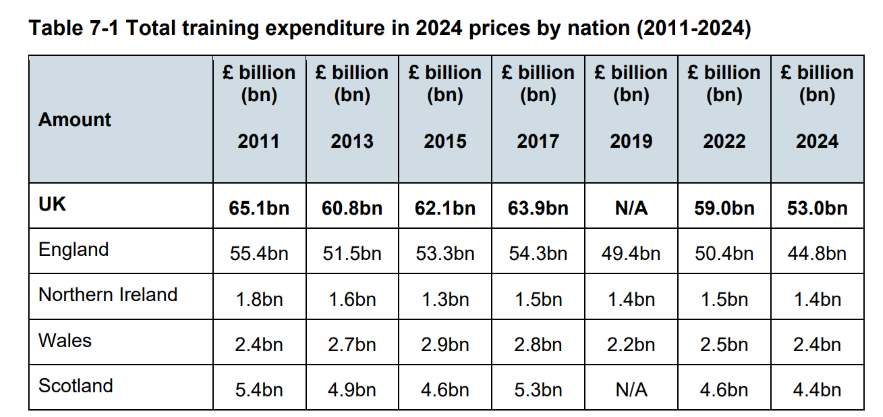
The latest Employment and Skills Survey for 2024 published last November (DfE, 2025) makes for very deeply depressing reading. It suggests that employers continue to report falling spending on training (see Box 1), down nearly 20% in 2024 prices since 2011, and falling expenditure per employee, down by 30% since 2011.
Box 1
Source: ESS 2024, November 2025
Four in ten employers offer no training at all, and for those that do train, half state they do enough. Compared to their EU counterparts, UK employers spend half the EU average on training per person.
Do policy makers care?
Public reaction by government to this oncoming crisis has been muted.
As the National Audit Office put it in 2022: “Government knows that employers’ spending on workforce training has fallen... but has not made clear to what extent it is seeking to influence employers to invest more in developing the skills of their own workforces.”
The current government has chosen to simply assume a happy ending, with its white paper on Post-16 Skills declaring: “We will ask businesses to fund the education and training their employees need to increase workforce productivity…” (DfE/DWP/DSIT, 2025: 10)
Given the figures noted above, this is a big ask, and the white paper is tactfully silent about what, if anything, might happen if and when many employers fail to step up to the plate.
Lower public funding on adult education and training
At the same time, state spending on adult education and training (E&T) provision at Level 3 and below has been reduced.
Since 2010, adult education and training (E&T) for work-related skills has dwindled in importance within the UK Government’s overall suite of educational policies. In real terms, government spending on adult skills is now 30% below what it was in 2010 (Vempalli et al, 2025).
Adult learning is largely a form of discretionary spending – the government does not have to provide for it. The vast bulk of public funding is now concentrated on forms of initial education that are mandated by legislation.
Moreover, budgetary pressures from fields such as health, social care, defence and housing mean that this is unlikely to change for the foreseeable future.
And concerns over higher education funding
Of course, the government’s banker seems to be the Lifelong Learning Entitlement (LLE) and the funding of upskilling and reskilling at Level 4-6. It is positive that maintenance loans will underpin the LLE and that targeted grants will be available to some extent for Level 4-6 provision linked to IS-8 sectors.
The problem is that whilst the LLE represents little change for under 25s, older adults are not too keen on taking fee loans out. In any case, it seems very few people actually know the LLE is starting in September 2026, let alone that it will be fully rolled out for AY2027/28.
A pincer movement
The pincer movement of reduced employer investment and falls in government spending is singularly unfortunate as the UK workforce faces massive challenges in terms of the need for upskilling and reskilling.
The government acknowledges that the nature of work is changing. Over the next decade, 26 million workers across the UK are expected to require upskilling as their roles evolve and 5 million workers will go through a more fundamental job change and require retraining (DfE/DWP/DSIT 2025: 18).
All this contributes to what is a high-stakes set of risks for Skills England, DWP, DSIT (regarding digital skills) and DfE.
Employer capacity to train
In parallel, another element in the employers and skills puzzle is our very limited knowledge and understanding of the embedded capacity within UK organisations to deliver training and development, and to design and direct on-the-job learning.
Without such capacity, the chances that the on-the-job element of apprenticeships can deliver high quality learning experiences are slender, and the same goes for many aspects of learning in and through work for adult employees.
Part of the reason for this is that an outsourced model of training has dominated UK government thinking, whereby firms contract out their training needs to independent training providers, FE and HE institutions and consultancies, in much the same way as security guarding, premises or office cleaning is outsourced.
There are many problems with this model, but a key one is that it is exceedingly hard for outsiders to design rich learning activities into work processes and job design or to monitor how well on-the-job provision is being delivered.
For this reason, nearly every EU country that has an apprenticeship system runs a ‘training of trainers’ programme to support provision, often reinforced by the mandatory requirement for workplaces that have apprentices to employ a certified trainer.
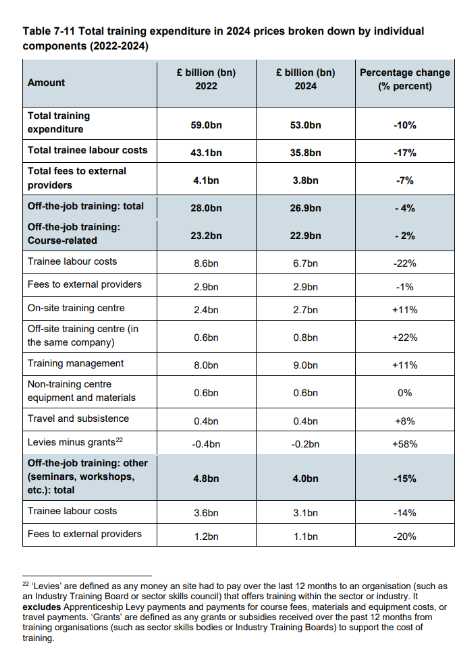
From what we can tell from ESS 2024, employer spending on trainer’s wages has fallen significantly recently and training centre spending is up a bit but still muted (see Box 2).
So dominant has the hold of the outsourced model on official thinking been that little or no effort has been expended on mapping or understanding the state, scale and nature of the systemic in-house training and development capacity of UK organisations. Again, in the absence of a clear picture on this topic, future apprenticeship and adult skills policy is going to be constructed on very shaky ground.
Box 2
Start researching now to inform policy as soon as possible
Given this daunting backdrop, it could be argued that there is now a cast iron case for research to investigate what thinking underlies employers’ choices on spending on employee skills, how this relates to and interacts with their chosen models of work organisation and job design, and what limits it might place on their adaptability and the ambitions involved in their competitive strategies.
If we do not understand how and why employers make the investment decisions they do, then working out ways to influence their choices and get them to spend more to greater productive effect is almost certainly impossible.
To put it another way, in the absence of such data and the insights it might generate, Skills England’s attempts to ‘tweak’ the apprenticeship levy into an effective Skills and Growth Levy are going to be conducted wearing a blindfold.
Without detailed research, policy is flying blind, at low altitude, in foggy weather, with the mountains approaching fast ahead.
REFERENCES
Department for Education. 2025. Employer Skills Survey 2024, www.gov.uk/government/statistics/employer-skills-survey-2024
Department for Education, Department for Work and Pensions, and Department for Science, Innovation and Technology. 2025. Post-16 Education and Skills, CP 1412, London: HMSO.
National Audit Office. 2022. Developing workforce skills for a strong economy, London: NAO.
Vempalli, S., Vaid, L., Revel, A., and Evans, S. 2025. No train no gain – Can the UK boost job mobility and pay growth over the next decade?, Leicester: Learning and Work Institute
Professor Ewart Keep holds the chair in Education, Training and Skills at the Department of Education, Oxford University
Our regular guest policy views are written by senior leaders and thinkers. They aim to stimulate discussion, identify issues and contribute to debate on post-16 education, skills and employment policy. The opinions expressed are the authors' own and do not necessarily express the views of the Campaign for Learning.