The Milburn Review of ‘Young People and Work’ is tasked with beating the NEET crisis. Towards the end of last year, just under 950,000 young people aged 16-24 in the UK were not in education, employment or training, a rate of 12.7%.
With the population of 16-24-year-olds forecast to rise above 8m by 2029, the number who would be NEET if the rate remained unchanged would be more than 1m.
The Milburn Review is due to publish its interim findings in the Spring and report to government by the Summer, with decisions informing the Autumn Budget.
It will need to take into account the measures set out in the Every Child Achieving and Thriving white paper (February 2026) and feed into the Government consultation on SEND Reforms (closing date 18 May 2026). At the same time, the Milburn Review will need to consider the Fonagy Review examining the rise in demand for NHS mental health, ADHD and autism services, and the Timms Review of personal independence payments (PIPs).
In effect, the Milburn Review faces two challenges.
The first is to propose reforms which prevent future generations of young people becoming NEET, although achieving zero is an impossibility.
The second challenge is keeping the number of young people who are NEET below 1m before the next general election. If not, the government could be open to the charge that Britain isn’t working for young people. The election must be held by August 2029 but will certainly be sooner.
Clarify the coverage of NEET policy
Devolution will have a critical bearing on policy towards NEET young people. As far as England is concerned, the Milburn Review must clarify once and for all which groups of young people are in scope.
Standard practice is to define the age group for NEET as 16-24-year-olds.
In England, the case for separating 16–17-year-olds and 18–24-year-olds from a policy perspective is largely based on the duty to participate in recognised education and training until the 18th birthday.
The rationale for a split between 18-21 and 22–24-year-olds is more tenuous, but it is largely because nearly 50% of 18–21-year-olds are in full-time education – mainly higher education – which encourages policy makers to focus on the other 50%.
At the end of 2024, there were nearly as many 22–24-year-olds who were NEET (375,000) as 18–21-year-olds (399,000), with 16–17-year-olds the smallest group (63,000). An estimated 18% (151,000) of NEET 18-24-year-olds had achieved a qualification at Level 4 and above, most of them graduates with degrees aged 22-24.
Neither 22–24-year-olds, nor young people with level 4 and above qualifications should be left out.
Job losses do not necessarily cause NEET numbers to rise
Everyone recognises that the weakening labour market is hitting young people hard. There are 71,000 fewer 16–24-year-olds in payrolled employment in the UK since the general election in July 2024.
Job losses do not, however, automatically translate into a rise in NEET numbers.
If young people in employment outside of full-time education lose their jobs, other things being equal, NEET levels will rise. If full-time students lose their jobs, NEET remains unaltered: only if they also drop-out of full-time education due to financial hardship will the numbers of NEET young people increase.
And more apprenticeships do not automatically cause NEET to fall
Counterintuitively, more young people on apprenticeships does not automatically cause NEET numbers to fall. If an employer trains an existing employee or recruits someone already in employment, NEET is unaltered. Only if employers recruit unemployed or inactive young people not in education will NEET fall.
But studying part-time can reduce levels of NEET in certain circumstances
Less commonly commented on is the fact that participation in part-time further or higher education can prevent young people from being NEET. If young people who are unemployed or inactive – claiming benefits or not – move into part-time study, NEET will fall.
Participation in full-time education is high but declines with age
The stand-out feature of the 16-24 education and labour market is the proportion of young people in full-time education, with 45% studying full-time (Table 1).
Table 1
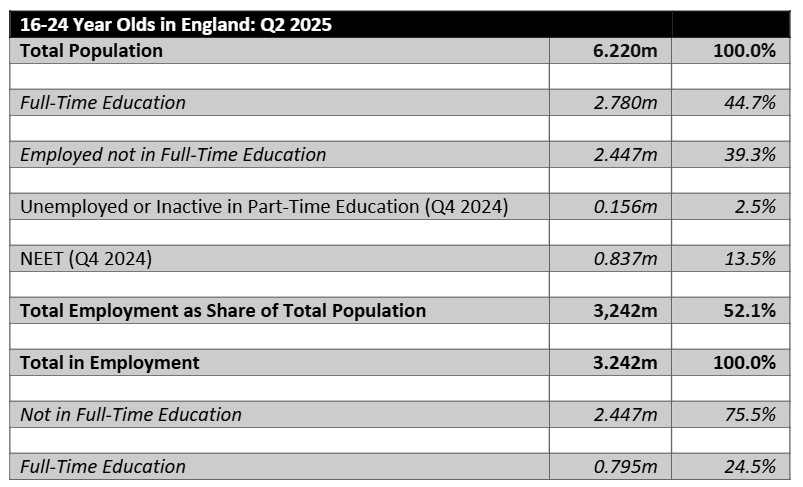
For 16–17-year-olds the rate is over 85%. Even 49% of the 18-21 age group study full-time.
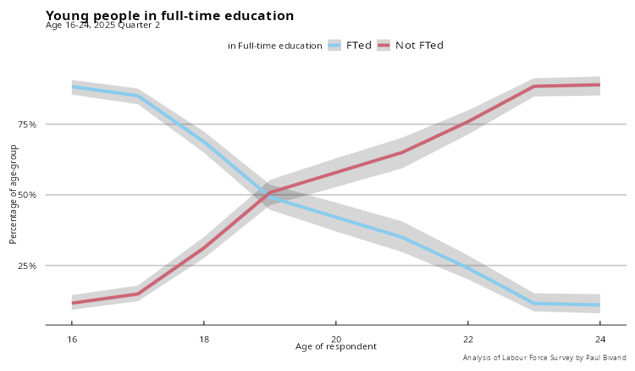
It is at age 22-24 that participation in full-time education plummets, dropping to 16% (Chart 1); whilst at age 24 this drops further to 10% (Chart 2).
There are two employment markets for 16-24-year-olds
Meanwhile, more than half of 16-24-year-olds (52%) are in employment (Table 1). But two labour markets are in operation: young people in full-time education and young people not in full-time education.
Nearly 75% of the 16-24 age group in employment are outside of full-time education (2.447m) and 25% are in full-time education (0.795m).
Chart 1
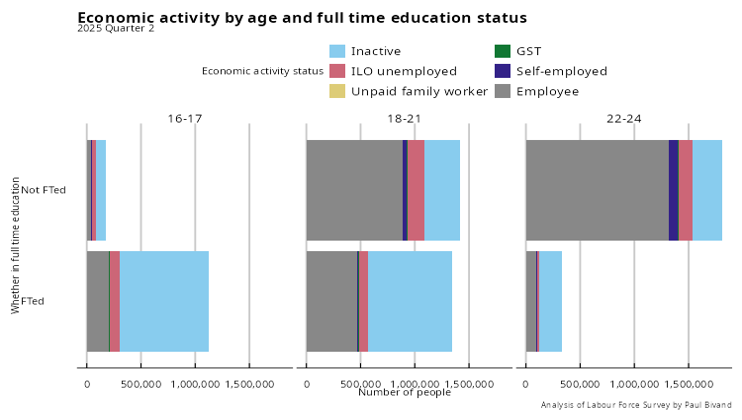
Chart 2
Although the type of employment is important too
The type of employment is also equally important to analyse.
Our best assessment is that nearly a third of 16-24-year-olds in employment – 1.020m out of 3.242m - are in atypical work: i.e. Zero Hour Contracts (ZHCs), temporary employment and self-employment (see Diagram 1).
For those in employment but not full-time students, 23% are atypical workers (0.552m out of 2.447m). This has important implications for the Youth Guarantee if it is to lead to secure jobs and the growth in apprenticeships.
For those who are full-time students, 59% of the employment opportunities available to them take the form of atypical work (0.468m out of 0.795m). Importantly, however, their wages are in addition to the living cost payments that support participation in full-time FE and HE.
Diagram 1
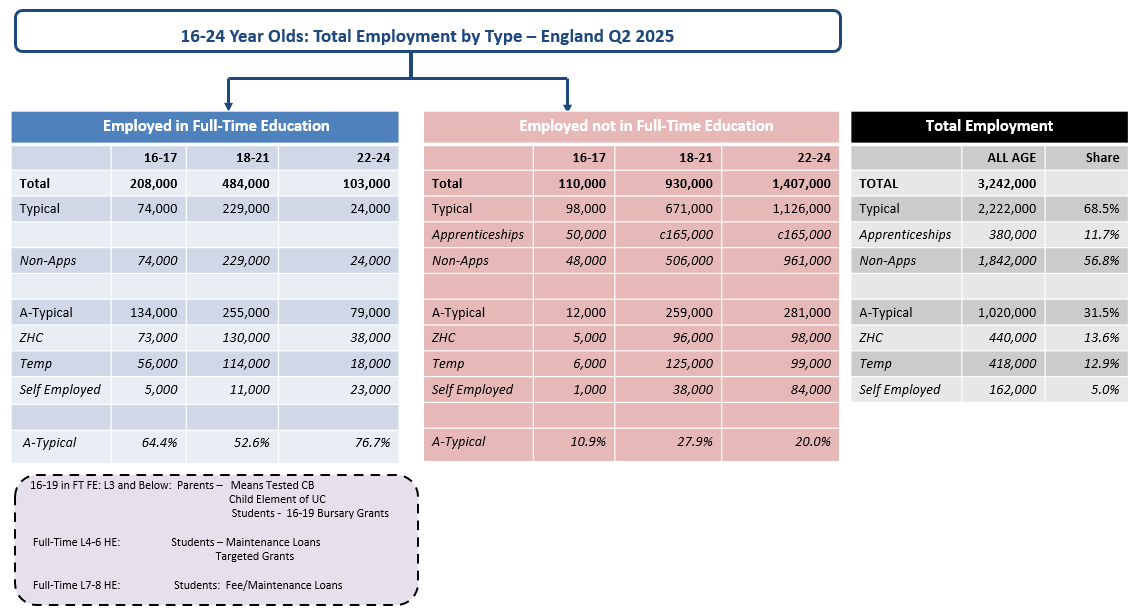
More 16-21-year-olds in full-time education are on ZHCs (203,000) than those not in full-time education (101,000). And more of the 16-21 age group in full-time education are in temporary employment (170,000) than those not in full-time education (131,000).
ZHCs are being reformed under the Employment Rights Act from 2027. The regulations will also extend to temporary workers. A government consultation is expected shortly.
Full-time education is a critical pathway for many disabled young people
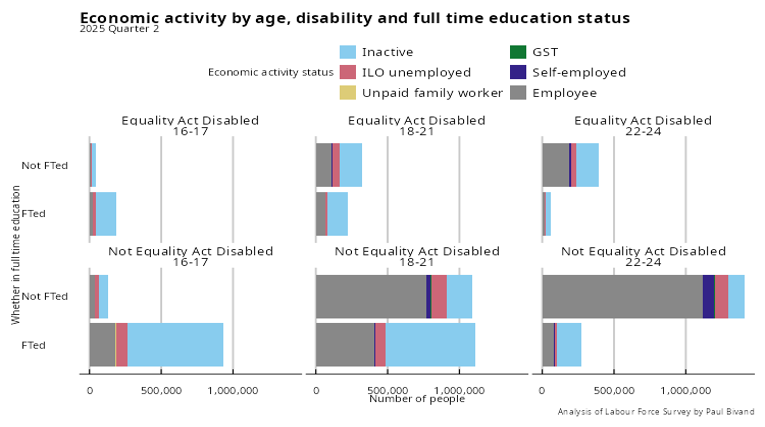
Rising numbers of 16-24-year-olds with a disability is key concern of the Milburn Review. Around 1 in 5 young people aged 16-24 have a disability.
There are nearly as many disabled young people aged 16-21 in full-time education (320,000) as not in full-time education (370,000), but most of them are unemployed or inactive than employed (Chart 3).
Chart 3
Minimum wage rates, labour regulations and employer tax reliefs has an impact on both students and non-students
Subject to economic conditions, young people aged 20 will be entitled to the adult rate of the National Minimum Wage (NMW) from April 2027. This will be followed by 18-19-year-olds (see Box 1) by April 2029.
Box 1
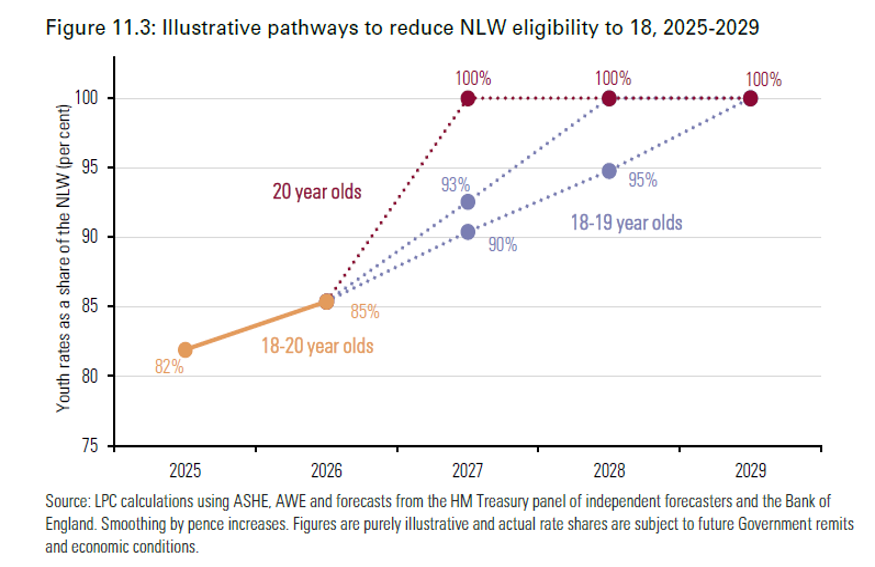
National Minimum Wage, Low Pay Commission Report, 2025
From January 2027, key provisions of the Employment Rights Act will be implemented, including the move from ‘zero hour’ to ‘guaranteed hour’ contracts which will also extend to temporary workers.
Reforms to the youth rates of the NMW and provisions in the ERA apply to both students and non-students (Table 2).
Table 2
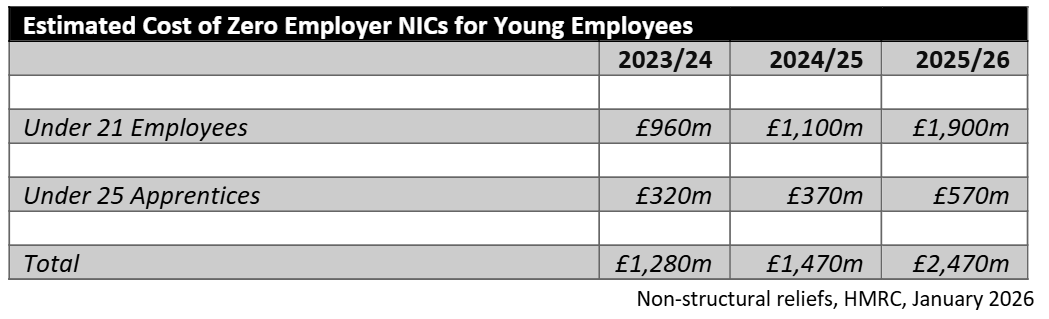
Zero employer National Insurance Contributions (NICs) apply to employees aged under 21. Latest estimates put the cost of the relief for 2025/26 at £1.9bn. The incentive is available to employers with employees who are under 21, both students and non-students.
Zero employer NICs also apply to apprentices aged under 25. The estimated cost is £570m in 2025/26, although the incentive is only applicable to non-student employees.
Removing these reliefs would cost employers £2.5bn, increasing the cost of retaining and hiring young people at a time when further labour cost hikes are in the pipeline.
Young people who have never worked is a problem but falls to 9% by age 24
The Milburn Review is rightly concerned about young people who have never worked.
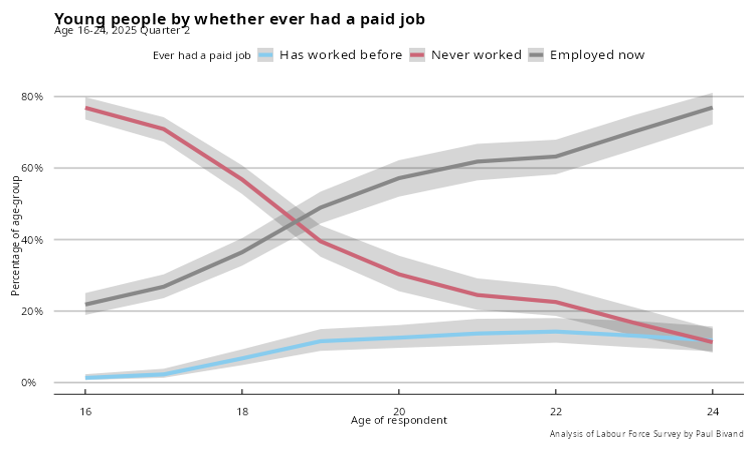
The proportion of 16-17-year-olds who have never worked has risen due to falling numbers of full-time students in employment.
By age 18, more than 50% of the age cohort have never worked. But by age 24 the rate falls to around 9% (see Chart 4), equivalent to about 62,000 young people. Of these, 27,000 (44%) are in full-time education and 35,000 (56%) are unemployed or inactive not in full-time education (although some might be studying part-time).
Our figures suggest that 5 in 100 young people aged 24 are ‘unemployed or inactive not in full-time education and have never worked’. We need to know much more about this group of 24-year-olds, but it is likely that many of these young people are disabled.
Of course, an obvious risk is that higher labour costs and regulation increase the number of young people who have never worked.
Chart 4
More 16–24-year-olds who are NEET are inactive than unemployed
Of the 837,000 young people aged 16-24 who were NEET at the end of 2024 in England, more were inactive (498,000) than unemployed (339,000). And of the inactive group, two fifths (209,000) were long-term or temporarily sick.
Although the share of 16–24-year-olds who are NEET and long-term or temporarily sick has been rising, most are aged 22-24
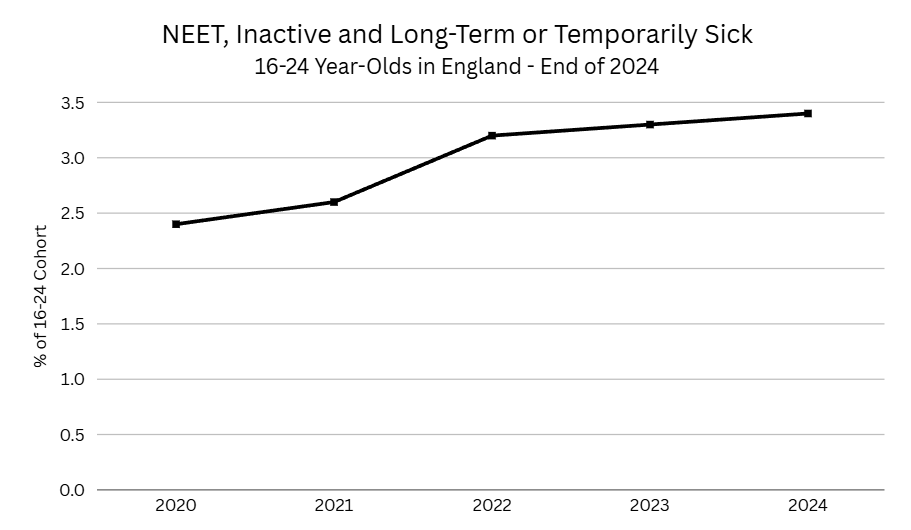
The share of 16–24-year-olds who are NEET and long-term or temporarily sick has steadily risen from 2.4% in 2020 to 3.4% in 2024 (Chart 5). Numerically, however, in 2024 there are more young people aged 22-24 (110,000) than 18-21 (89,000) and 16-17 (10,000).
Chart 5
https://www.gov.uk/government/statistics/neet-age-16-to-24-2024
Only around half of 16–24-year-olds who are NEET claim benefits
Research by the Learning and Work Institute shows that 53% of 16–24-year-olds who were NEET in England at the end of 2024 claimed benefits (The Youth Guarantee and the Benefit System, 2025).
Universal Credit (UC) claimants are placed into three groups: fit for work, limited capability to work (LCW), and limited capability of work-related activity (LCWRA).
Of the 444,000 young people in England claiming benefits, 250,000 were claiming Universal Credit (with a duty to look for work); 83,000 were claiming the health element of Universal Credit (without a duty to look for work), and the remaining 110,000 were claiming long-term disability benefits including PIP.
Shifting young people out of the LCWRA group to the Fit to Work group could leave NEET unchanged
The government is seeking to shift young people out of the LCWRA group – where there is no duty to look for work and the health element of UC is paid - into the Fit for Work group – where a duty to look for work is required and a lower overall amount of UC is paid. As a consequence, the number of 18–24-year-olds who are inactive and NEET would fall. Even so, there might be no change in the NEET total as the number of young people who were unemployed and NEET would rise.
NEET young people not claiming benefits – who are they?
Of the 837,000 young people aged 16-24 in England who were NEET at the end of 2024, around 47% did not claim any type of benefit. To inform policy development, the Milburn Review should analyse the characteristics of these young people, including their age, where they live, the highest level of qualification they hold and if they are part of the informal economy.
A challenging environment for the Youth Guarantee for 18–24-year-olds
The aim of the Youth Guarantee is to assist 18–24-year-olds claiming Universal Credit to find secure, well-paid employment outside of full-time education.
Today, nearly a quarter of employment opportunities for 18–24-year-olds not in full-time time education take the form of ZHCs, self-employment and temporary employment. Unemployment is rising. The AI revolution is both creating and destroying jobs. Higher youth rates of the national minimum wage and implementation of ERA are timed for 2027 onwards.
Employer demand for work placements could be constrained. A focus on job search, CV writing and motivational seminars when employment opportunities are falling is a daunting prospect for young benefit claimants.
NEET numbers at 16 is relatively low
The list of risk factors determining NEET status at 16 is extensive.
In terms of special educational needs and disability, around 1.7m pupils under 16 have a SEND diagnosis; 6% have Education, Care and Health Plans (c45,000) and 9% receive Disability Living Allowance (c65,000).
In relation to economic disadvantage, 12% live in material poverty although this is expected to fall with the removal of the two-child welfare limit regarding the child element of Universal Credit.
Turning to education, 30% of 15-year-olds have poor attitudes towards secondary school and 27% fail to achieve grade 4 or higher in GCSE maths and English.
With all of these factors influencing NEET status at 16, it is surprising that the NEET rate is only 4.8%. Young people, with the support of their parents and guardians, seem to do everything possible not to be NEET. And full-time further education is the pathway many end up following.
But NEET numbers at 16 could rise in the future
Despite the fact the population of 5-15-year-olds is forecast to fall in the coming decade, the government is concerned that more younger children are being diagnosed with SEND and more are being awarded ECHPs. This suggests that NEET at 16 could rise due to structural reasons. Spending on Disability Living Allowance to age 16 is also forecast to increase.
Reduced disability benefits could cause NEET numbers to rise
Somewhere in the region of 65,000 children aged 15 receive Disability Living Allowance. Over 88% transition to PIP (Britain is going to hell in a handcart, says Starmer’s worklessness tsar, Telegraph, 8th February 2026) although the eligibility criteria are different. Overall, 379,500 16–24-year-olds claimed PIP in September 2025, up from 184,800 in the same month in 2020.
Crucially, however, PIP is not an in-work benefit. It is currently paid irrespective of economic and education status. Some young people aged 16-24 receiving PIP are employed, although it is unknown how many are in education. Others will be in full-time or part-time education but not in employment.
If PIP payments are reduced, causing 16–24-year-olds in employment or education to drop-out because of financial hardship, NEET numbers would rise.
Around 70,000 young people aged 18-21 claim the health element of Universal Credit for 18–21-year-olds because they have limited capability for work-related activity (LCWRA). It remains unclear whether the government intends to withdraw the benefit for this age group.
16–21-year-olds in receipt of the health element of UC who are not in full-time education and who subsequently enter full-time education retain eligibility for payment. If the abolition of the health element of UC causes drop-out from full-time education – including higher education – NEET numbers would rise.
Acquiring a disability
Clearly, young people can acquire a disability before they reach the age of 16 and they can retain their disability to 24 and beyond.
For instance, the findings of a recent study by University College London has found that exam stress at age 15 – when high stake GCSES are sat - can lead to anxiety and depression during early adulthood (More exam stress at 15 linked to higher risk of depression as young adult, Guardian, 12th February 2026). Of 15-year-olds in receipt of DLA, 80% go on to claim PIP at age 16.
Equally, young people can acquire a disability when they are aged 16-24 and not necessarily aged pre-16.
Charting a way ahead
Short-term interventions
1. Develop a combined but segmented Education and Employment Participation Strategy for 16-24-year-olds
The Milburn Review should revisit ‘Building Engagement, Building Futures: A Strategy to Maximise the Participation of 16–24-Year-Olds in Education, Training and Work’ published by the former Coalition Government in December 2011. The approach taken in the white paper includes preventing young people becoming NEET before age 16 as well as a participation strategy for 16–17-year-olds and 18–24-year-olds.
To beat the NEET crisis today, the Milburn Review should develop a combined education and employment participation strategy. But rather than segment 16–24-year-olds in terms of 16-17- and 18–24-year-olds, it should craft a strategy based on 16-17-year-olds, 18–21-year-olds and 22–24-year-olds with specific rationales.
2. Let participation in post-16 full-time education reduce NEET numbers
Young people in full-time education are not NEET. In a weak youth labour market - where job opportunities are limited - participation in full-time FE and HE tends to rise. Preventing drop out from education is key. With limited hiring, young people that drop out could become NEET.
3. Higher participation in full-time study must go hand-in-hand with greater employment opportunities
In today’s uncertain world of work, a mechanical reduction in NEET numbers caused by rising participation in full-time education cannot be a goal in itself. A ‘bums on seat’ approach is unsupportable.
Full-time study must lead to employment at some stage, including for disabled students where possible. To support their post-education and longer-term employability, students need to maximise their grades alongside working, including during term-time if need be.
Four policy areas must be addressed to allow participation in full-time education to rise, combined with employment where possible, to prevent young people becoming NEET in the short and long term.
First, demand from young people for full-time education should be met. This will need adequate funding for extra places in 16-19 further education, no student caps on full-time Level 4-6 higher education, extra places for teacher training and no limit on Level 7-8 postgraduate study.
Second, adequate living cost support is required to avoid financial hardship causing drop-out from education.
For 16-19 further education this means adequate financial support to parents – in the form of means-tested child benefit, and the child element of Universal Credit – and to students in the form of the 16-19 Bursary Grant. If the reintroduction of Education Maintenance Allowances is unaffordable, the relatively small 16-19 Bursary Grant could be increased.
For full-time higher education, adequate maintenance loans are needed, although the decision to introduce targeted maintenance grants is a positive move.
A mixed package of full-time and part-time maintenance loans and grants should be made available to 19–24-year-olds seeking to achieve a first Level 3. This could be linked, perhaps, to industrial strategy sectors.
Third, further education and higher education provision must be made relevant to labour market needs with sufficient time made available to secure appropriate licenses to practice.
And fourth, employment policies need to underpin and not undermine student employment.
4. Stress-test the impact of the 16-19 Qualification Reforms on NEET numbers
The Department for Education is implementing reforms of 16-19 qualifications as set out in the Post-16 Education and Skills white paper published in October 2025. The Milburn Review should stress-test these reforms against any potential rise in NEET numbers during the transition phase and lack of flexible provision for disadvantaged learners.
5. Bring full-time higher education into the NEET debate
The Milburn Review should explicitly bring full-time higher education policy into the debate on addressing NEET. Such a move would also link the NEET debate to the target of two-thirds of under 25-year-olds participating in academic and technical education, and apprenticeships at Level 4 and above.
6. Strengthen support for disabled 16–24-year-olds in full-time education
Full-time education is a clear pathway for young people with disabilities. Colleges and universities should receive adequate funding to provide support services, so they avoid dropping out and becoming NEET. The Milburn Review should consider the adequacy of the 16-19 Bursary Grant in relation to its extension to under-25-year-olds with Education, Health and Care Plans (ECHPs). It should also assess the work of the Disabled Students Commission established by the Office for Students and the adequacy of the Disabled Students Allowance.
7. Carefully weigh up the ‘combined’ impact of higher minimum wages and reforms in the Employment Rights Act on young people
Usually, employment reforms are introduced when employment is growing. Higher minimum wages for young people – including 16–17-year-olds – and added employment rights under the ERA may be desirable as individual policies. But the problem arises when two flagship policies are timed to be implemented together. This could adversely affect employment for young people and exacerbating the NEET crisis.
On present plans, 2027 will be a key year for youth employment. This is when 20-year-olds will shift from the youth rate to the adult rate of the National Minimum Wage (NMW) and key provisions in the Employment Rights Act come into effect.
It is unclear how these policies will impact on the level of employment or the type of employment offered to students and non-students alike. Hiring could be lower. Employers might turn towards less regulated employment, including self-employment.
The government could consider introducing the provisions of the Employment Rights Act timed for 2027 whilst delaying the shift of 20-year-olds to the adult rate of the NMW until, say, April 2028. If this were to happen, the change would likely take place this side of the general election.
The government should also consider whether it is desirable for 18-19-year-olds to shift to the adult rate of the NMW from April 2029 - after the next general election – if at all.
Many full-time students work on Zero Hour Contracts. They could be exempted from the move to Guaranteed Hour Contracts.
8. Bring the Department for Business and Trade into the debate on NEET young people
Closer working between the Department for Education and the Department for Work and Pensions is a necessary but insufficient condition to develop a joined-up participation strategy at national level to beating the NEET crisis. As the sponsor ministry for the ERA and the NMW, the Department for Business and Trade must be at the heart of the NEET debate.
9. Extend zero employer NICs to employees aged under 22
Currently, zero employer NICs is available to employees aged under 21. To provide extra support for employers to recruit 21-year-olds – students and non-students, employer zero NICs should be extended to under 22-year-olds.
10. Extend zero employer NICs to disabled employees aged under 25
Zero employer NICs currently apply to all employees under 21 including those with a disability, declared or otherwise. The relief should be extended specifically to cover disabled employees aged under 25 to give employers an incentive to retain and hire them, whether they are in full-time education or not in full-time education. Eligibility could be determined according to receiving Access to Work funding or Personal Independence Payments. This proposal should be considered by the Milburn Review and fed into the Government consultation on SEND Reforms.
11. Create a Part-Time Adult Education Strategy to reduce NEET numbers
Allowing more young people who are unemployed or inactive not in full-time education to study part-time reduces NEET numbers.
The Milburn Review should assess how a greater share of the 19+ Adult Skills Fund can be targeted on 19–24-year-olds who are NEET to enter part-time adult FE. It should consider the role of fee loans and maintenance loans and grants to enable under 25-year-olds who are NEET to participate in part-time Level 4-7 higher education.
The Milburn Review should assess the adequacy of financial and maintenance support to disabled young people studying in part-time adult FE and higher education.
Critically, thought should be given to ways in which Universal Credit can be made more flexible to facilitate greater participation in adult further and higher education to prevent NEET.
12. Reform the Youth Guarantee for 18–24-year-olds and the role of Jobcentre Plus
The Milburn Review should propose that the Youth Guarantee incorporates a clear full-time skills training pathway, enabling young people to get the qualifications they need to secure good jobs. This should include re-sitting GCSE maths and English if young people wish to do so.
In addition, the review should consider how the Youth Guarantee will specifically assist the 150,000 18–24-year-olds who are NEET and hold qualifications at Level 4 and above. Some of this group will be disabled who have left higher education and cannot find work or who are unable to work.
More widely, Jobcentre Plus should be mandated to support young people in full-time education to find work whilst studying, as well as those who are NEET who are claiming benefits and not claiming benefits.
The partnership between DWP and the MOD to encourage young people to join the armed forces is a welcome step to reduce NEET, especially through the location in Job Centres of career advisers from the armed forces.
13. Offer wage grants to non-levy paying employers to recruit apprentices aged 16-21 who are NEET
Wage grants of £3,000 should be offered to non-levy paying employers who recruit 16–21-year-olds who have been NEET for 6 months or more on apprenticeships at Level 2 and Level 3. These grants should be in addition to existing grants to 16–24-year-olds and zero employer NICs for under 25 apprentices. Funding should come out of the £140m that was allocated at the Autumn Budget to engage small firms in apprenticeships over three years.
Longer-term interventions
14. Deliver a stronger vocational offer for 14–15-year-olds
The principle of a general academic education until 16 should be reconsidered. The Milburn Review should propose a stronger vocational offer at Key Stage 4, with clear pathways to vocational education and apprenticeships from age 16. This could be a forerunner to a 14-19 academic and technical education system.
15. Place a greater focus on GCSE maths and English attainment pre-16
The consequence of poor performance in GCSE maths and English at 15 means 16-18 further education is landed with a critical repair job. The Milburn Review should propose a stronger pre-16 strategy from Key Stage 2 onwards.
16. Consider rising numbers of children with EHCPs and in receipt of Disability Living Allowance together
A great deal of attention by the education sector is focused on the future reforms to SEND and the consultation which closes on the 18 May 2026. But reforms to EHCPs must be considered alongside future reforms to Disability Living Allowance. The Milburn Review must fill this glaring omission in the SEND Reform consultation.
17. Examine the implications of extending Disability Living Allowance payments to the 18th birthday on post-18 transitions
At present, Disability Living Allowance (DLA) paid to parents with disabled children ends when the child reaches 16. Just before they are 16, the young person must make a claim for PIP. This benefit transition occurs when disabled young people are completing their GCSEs and deciding their post-16 options.
The government has signalled that DLA could be extended to the 18th birthday. This would mean young people making a claim for PIP just before they reach 18. This benefit transition would occur when disabled young people are completing Level 2 and Level 3 courses and considering post-18 options. The Milburn Review should assess the implications of such a move on transitions to post-18 options, including continuing full-time FE until age 19, entry into full-time HE and employment outside of full-time study.
18. Be clear over a NEET or Duty to Participate Policy for 16-17-year-olds
The NEET category is different from the ‘not meeting the duty to participate’ category. The NEET rate for 16–17-year-olds is 4.6%. The ‘not meeting the duty to participate’ rate is 7.7%.
Young people in jobs without training, jobs without recognised training or studying part-time whilst unemployed or inactive reduce NEET numbers, but these young people are not classed as meeting the duty to participate.
The Milburn Review must decide whether to propose a reinvigorated participation age strategy or a NEET prevention strategy.
19. Assess the impact of any future cuts to PIP and the health element of Universal Credit on NEET
The Milburn Review should assess whether any future cuts to PIP will lead 16–24-year-olds in employment or education to drop-out, causing NEET numbers to rise. Similarly, it should assess how many 18–21-year-olds are in full-time education and claiming the health element of Universal Credit, and if it is withdrawn, the potential impact on drop-out and NEET.
20. A Youth Allowance for 16-21 Year Olds – who will be paid?
There are suggestions that the Milburn Review could propose a Youth Allowance for 16–21-year-olds.
A key issue for the design is whether the allowance will be paid to unemployed 16–17-year-olds looking for work, given at present they are not entitled to Universal Credit.
If the allowance is paid to young people, it would represent a major change from the present system. Although higher education students have maintenance support paid directly to them, the vast majority of financial support for 16–19-year-olds in further education is paid to parents in the form of means-tested child benefit and the child element in Universal Credit.
Paul Bivand is a Labour Market Analyst and Mark Corney is a Senior Policy Adviser at Campaign for Learning
Published 25 February 2026
Between October 2025 and January 2026, Campaign for Learning organised and facilitated four roundtables with representatives from FE, HE, ITPs and employer bodies. These events have influenced this policy blog but the views remain entirely those of the authors.