The Prime Minister reconfirmed at the Labour Party conference that government policy is to “reduce net migration and our economic dependency on it.”
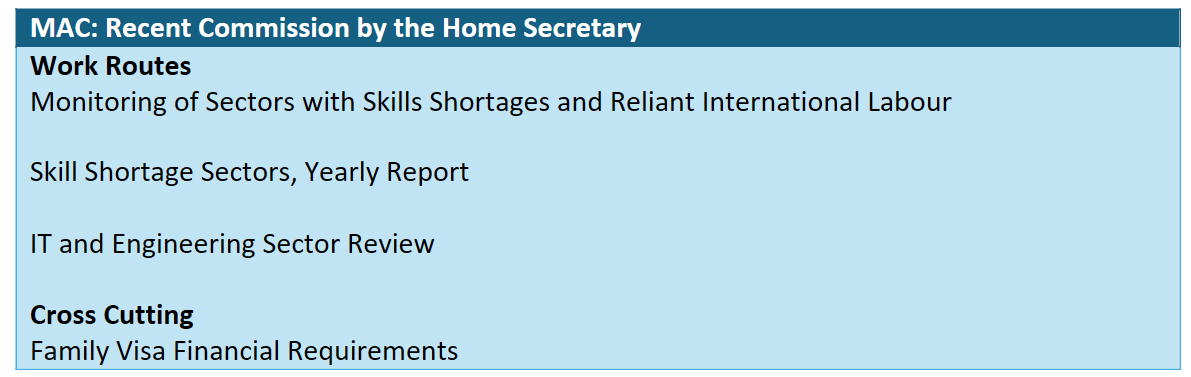
The Home Secretary doubled down on this message by announcing that the Migration Advisory Committee (MAC) will be tasked with proactively monitoring sectors where skills shortages are leading to surges in overseas recruitment and provide a yearly assessment to ministers to inform policy making (Press Notice, 24th Home Office, September 2024).
The announcement builds on the commission by the Home Secretary in August for MAC to review demand for visas in occupations in the engineering and IT sectors (see Box 1).
Box 1
Source: www.gov.uk/government/news/new-measures-set-out-to-reduce-net-migration
As part of the commission earlier in August, the Home Secretary stated:
“the Migration Advisory Committee, the newly formed Skills England, with their responsibility for identifying skills gaps across the labour market, and the Industrial Strategy Council, together with input from DWP, will work closely to develop a more structured and evidence-based approach to the labour market.
These bodies will:
• Collate and compare the data and evidence they hold; and meet on a quarterly basis to use this data to diagnose which sectors are facing significant labour shortages and the reasons why.
• Report to Ministers which will work in tandem with industry and sector bodies as appropriate to take forward plans to address labour and skills shortages in key sectors.” (Letter from the Home Secretary to the Chair of MAC, 6th August 2024)
Skills policy is complex. Migration policy is arguably more so. And the overlaps are wide-ranging.
In this long-read, we attempt to assess the complexities and challenges on bringing skills and migration policy together, and how Skills England (SE) and MAC must work together.
Net migration
Net migration is the difference between immigration and emigration. Data is regularly published by the Office for National Statistics and the Home Office.
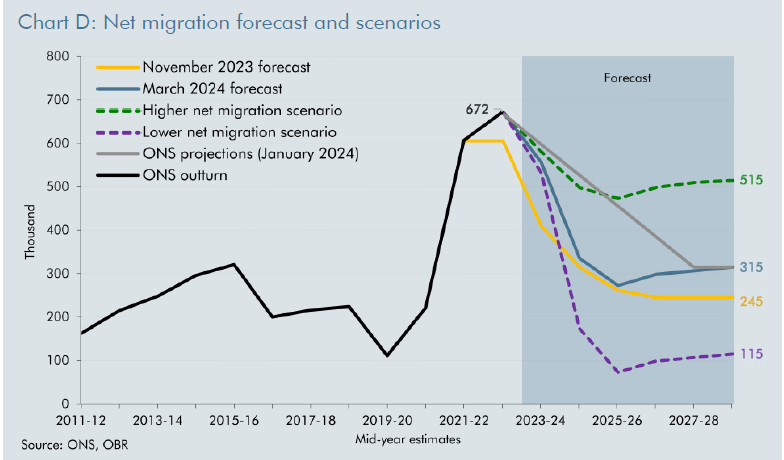
This data is also used by the Office for Budget Responsibility (OBR) when preparing economic and fiscal forecasts. In March 2024, the central forecast of the OBR was for net migration to fall from a peak of 672,000 in 2022/23 to 315,000 in 2027/28 (see Box 2).
Box 2
https://obr.uk/efo/economic-and-fiscal-outlook-march-2024/
More recent assessments suggest that net migration into the UK might fall to around 250,000 by the end of the decade, although still above pre-Brexit levels (Net migration to fall but will still be more than pre-Brexit, The Times 9th October 2024).
Immigration
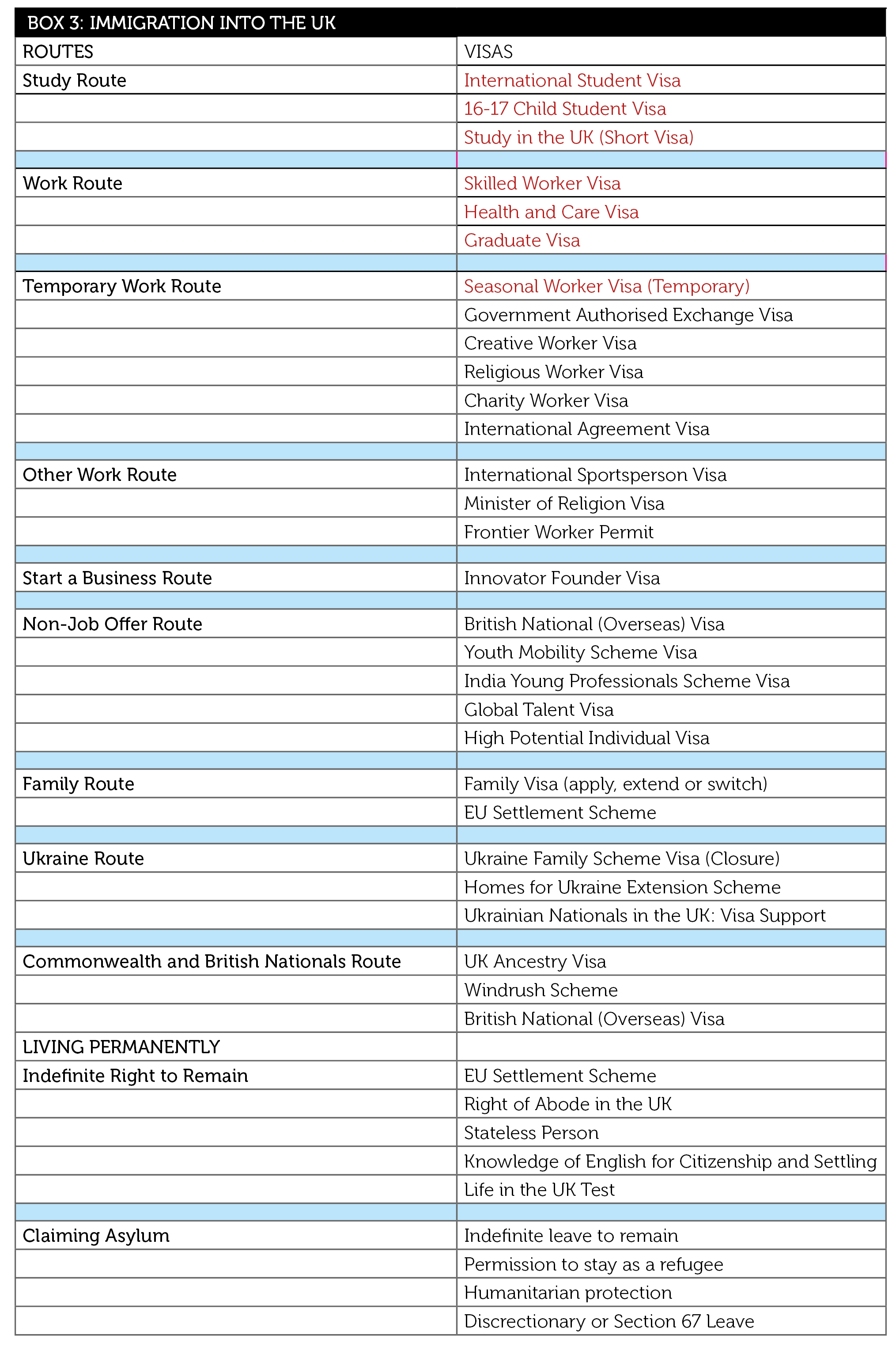
The Home Office (HO) is responsible for UK immigration policy. There are at least nine routes linked to legal immigration, each with a series of VISAs allowing entry into the UK (see Box 3). Yet, immigration policy is even more complex: switching between routes and visas is also possible.
Long-term immigration
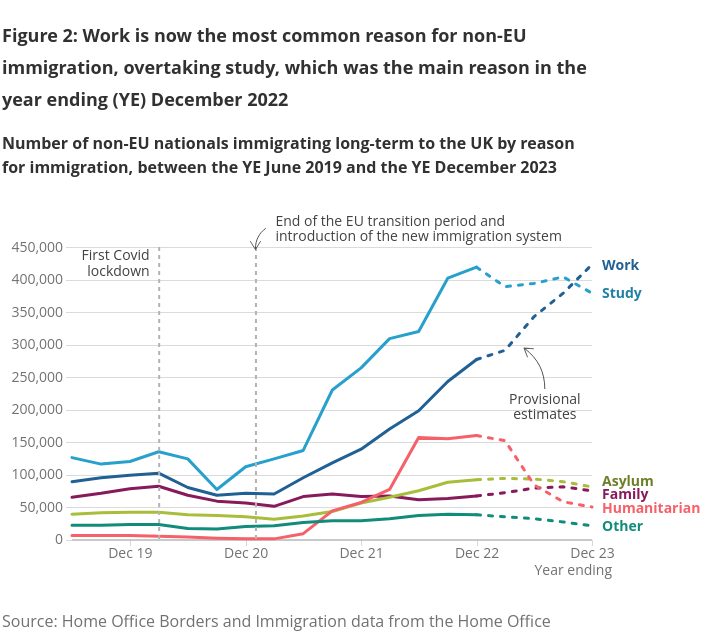
Since the end of free movement of people between the UK and the EU at the end of 2020, Home Office data on long-term immigration shows that the main reasons for the rapid rise in non-EU nationals entering the UK have been to study or work (see Box 4).
UK immigration for study
A classic example of the overlap between immigration policy, administered by the Home Office, and post-16 education and training, administered by the DfE and the devolved nations), is international students coming to study in the UK.
Box 3
www.gov.uk/browse/visas-immigration
https://www.gov.uk/government/organisations/migration-advisory-committee
Box 4
Source: www.ons.gov.uk/peoplepopulationandcommunity/populationandmigration/internationalmigration/bulletins/longterminternationalmigrationprovisional/yearendingdecember2023
International Students and their dependants increase immigration in the short-term, although somewhat controversially are counted in the total for long-term immigration given that most leave upon graduation. International students are also vital to the finances of UK higher education institutions, especially universities.
During their studies, they and their dependants are able to work, and upon graduation can stay in the UK to work for up to two years. They can also switch to become skilled workers rather than graduate workers.
International Student Visas, Graduate Visas and Skilled Worker Visas
On entering government, Labour made three quick decisions regarding international students and their dependants.
First, it decided to retain international students as part of the long-term migration statistics.
Second, it decided not to introduce a cap on international student visas.
And third, it continued with restricting dependants of international students entering the UK.
A Home Office impact assessment conducted in March 2023 under the last government, estimated that there could be 28,000 fewer post-graduate students and 150,000 fewer dependants per year following the changes. The cost in lost tuition fees to UK HE could be £5bn over a ten-year period (2023 Changes to the Student Route and Consequential Changes to Work Routes: Impact Assessment, Home Office, 27th September 2024).
International students on Graduate Visas can also switch to Skilled Worker Visas and especially Health and Care Visas. In March 2023, HO estimated there will be 27,000 fewer students and 108,000 fewer dependants with Graduate Visas and Skilled Worker Visas in 2026/27 (Home Office, 27th September 2024).
UK Immigration for work
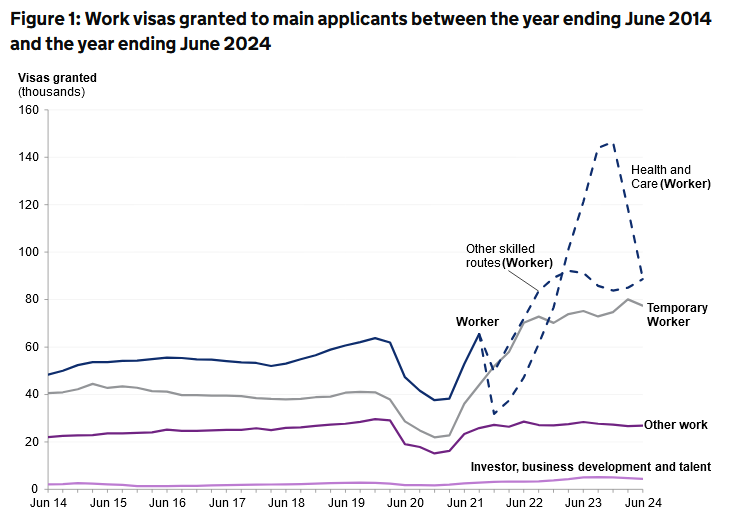
At the end of 2023, worker immigration peaked at just over 400,000.
About 80,000 visas were issued under the temporary work route (see Box 5) which includes the Seasonal Worker Visa.
Around 230,000 were issued under the work route, including Skilled Worker Visas (c85,000) and Health and Care Visas (c145,000).
These totals include switching from Graduate Visas.
Box 5
Source: www.gov.uk/government/statistics/immigration-system-statistics-year-ending-june-2024/why-do-people-come-to-the-uk-to-work
Skilled Worker Visas: Pre-April 2024
Under the old system, the minimum salary for a standard skilled worker vacancy was £26,200 or the going rate, whichever was the higher. The effect was to restrict employer recruitment of migrant workers into many skilled trades. Only 22% of skilled worker visas were issued for skilled occupations (c20,000 roles): the remaining 78% were for professional, managerial and associate professional job roles (c66,000 roles).
Health and Care Visas: Pre-April 2024
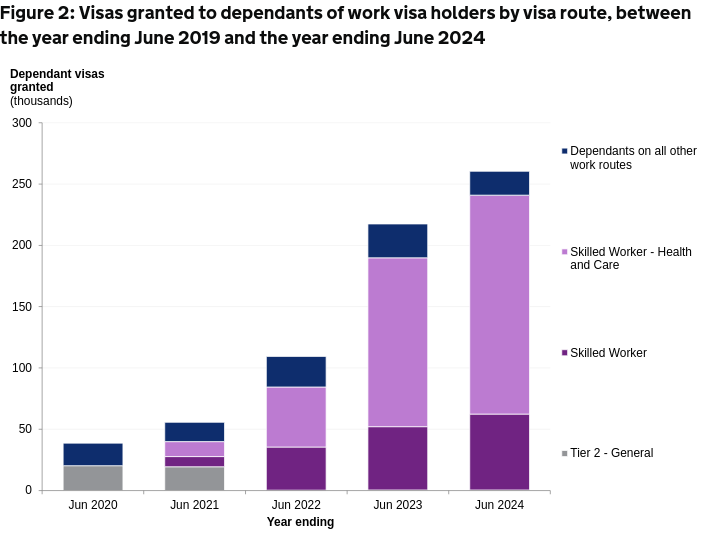
The minimum salary for Health and Care Visas was £23,200. During 2023, the Home Office noticed that as more health and care workers entered the UK, the number of dependants also increased (see Box 6).
April 2024: worker immigration system
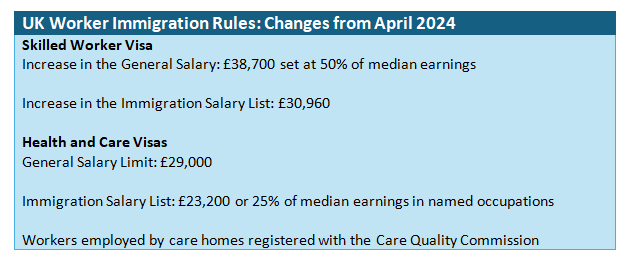
Alongside changes to international students, the Labour Government retained the package of measures introduced by the last government to reduce worker immigration (see Box 7).
Box 6
Source: www.gov.uk/government/statistics/immigration-system-statistics-year-ending-june-2024/why-do-people-come-to-the-uk-to-work
Box 7
April 2024: Skilled Worker Visas
The changes to Skilled Worker salary requirements were designed to better protect against undercutting of resident workers and help reduce net migration.
The Home Office completed an impact assessment on Skilled Worker Visas in March 2024 (2024 Immigration Rule Changes, Impact Assessment, Home Office, September 2024). It estimated that the number on Skilled Worker Visas would fall by 15,000 during 2024/25 for main applicants and 10,000 for dependants.
The main sectors likely to be affected were accommodation and food, other services, wholesale and retail, and motor repair.
April 2024: Health and Social Care Visas
The previous government argued that the changes with respect of care workers were designed to address the high levels of non-compliance, exploitation and immigration abuse within the adult social care sector, whilst allowing genuine care providers access to overseas recruitment.
The Home Office estimated that 35,000 fewer health and care visas would be granted during 2024/25 and 200,000 fewer for dependants in 2024 (2024 Immigration Rule Changes, Impact Assessment, Home Office, September 2024), although the fall seems to have been slightly greater at c45,000 (see Box 5).
Skill shortage vacancies and Skilled Worker Visas
According to the Employer Skills Survey, employers reported 1.48m vacancies during 2022 (ESS 2022, DfE December 2023). Of these, 531,000 (36%) were skill shortage vacancies.
In the year ending June 2022, the total number of work-related visas – excluding temporary workers and other workers – was around 150,000, with 80,000 having Skilled Worker Visas and 70,000 with Health and Care Visas (see Box 5).
Before April 2024, the Skilled Worker Route appeared to be contributing towards filling 15% of skill shortage vacancies which could have been left unfilled.
Skilled Workers Visas and the Immigration Skills Charge
Integral to the UK immigration system is a series of fees and charges. Fees are charged to applicants for Skilled Worker Visas. Successful applicants must also pay the Immigration Healthcare Surcharge.
Meanwhile, sponsoring employers must pay the Immigration Skills Charge (ISC) for each year a Skilled Worker Visa lasts (which is a maximum of 5 years). Ostensibly, the aim of the ISC is to use the revenue raised to directly invest in skills at home. In 2022/23, the ISC raised £568m but there is no direct allocation by the Treasury to DfE or the devolved nations for skills.
DfE and skills policy
Policy oversight for skills policy in England rests with DfE. Skills policy is defined as 16-19 education, adult further education and apprenticeships. Post-16 skills policy covers Level 3 and below provision and a small element of Level 4-7 provision.
DfE is also responsible for a separate area of post-16 policy-regulated higher education. This is overseen by the Office for Students - which includes Level 4-5 vocational sub-degrees, Level 6 first degrees and Level 7-8 post-graduate degrees.
Skills England
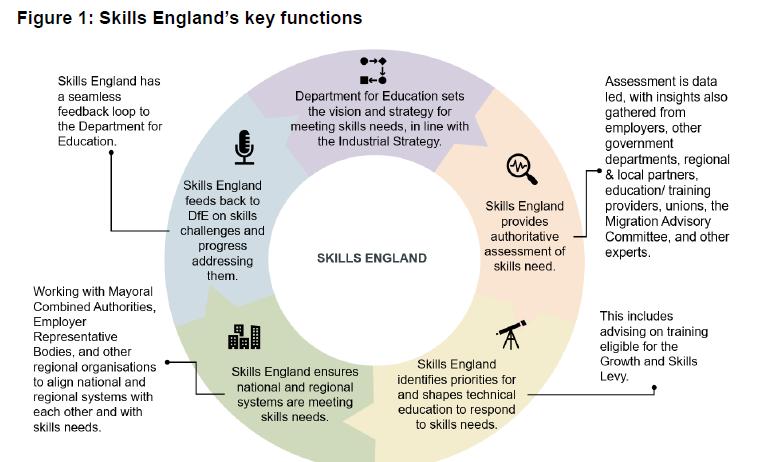
In late September, the DfE published Skills England: Driving growth and widening opportunities. The ultimate aim of Skills England is to be the driving force for upskilling and reskilling of the economy.
Skills England and short-term worker immigration policy
The report states Skills England will work closely with MAC “so that growing a domestic skills pipeline supports reduced reliance on overseas workers.”
In producing authoritative national and regional skills assessments, Skills England will work closely with the Migration Advisory Committee (see Box 8).
Box 8
Source: www.gov.uk/government/publications/skills-england-report-driving-growth-and-widening-opportunities
The report also identifies that a flexible labour market and easy access to migrant workers has potentially contributed to lower employer spending on training.
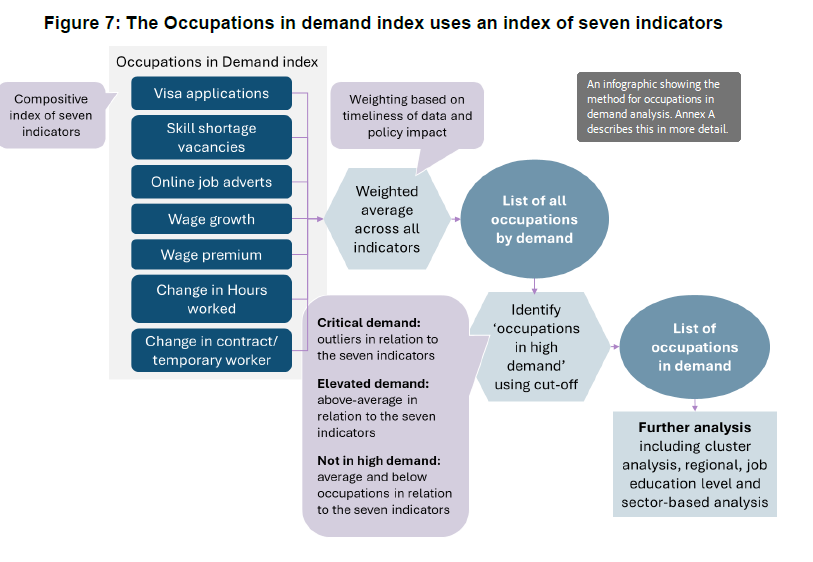
Visa applications and employer reported vacancies are included in a new seven-factor composite Occupations in Demand Index based on 400 or so occupations at the 4-digit level (see Box 9).
Box 9
www.gov.uk/government/publications/skills-england-report-driving-growth-and-widening-opportunities
There are around 2.5m people in occupations which are in critical demand: 20% (0.5m) require Level 6 and above qualifications, and 80% (2.1m) require Level 2-5 qualifications. Elementary occupations requiring Level 2 skills include farm workers, construction ground workers, cleaners and care workers.
However, 15.1m people are in occupations in critical and elevated demand. When these jobs are mapped against Level 2-8 qualifications, DfE finds that 8.8m (58%) require Level 2-5 qualifications and 6.3m (42%) require Level 6 and above qualifications.
Meanwhile, the two sectors which have the highest volume of employment in occupations in critical and elevated demand are health and social care, and education. Certainly, the Occupations in Demand index bolsters the case for a separate Health and Care Visa alongside Skilled Worker Visas.
Given the salary thresholds of £38,700 and £30,760 for Skilled Worker Visas, interventions other than worker immigration are the key to filling most job roles requiring Level 3 and below qualifications, especially those in critical demand.
Employers will need to increase pay and improve working conditions, prompted by the government for those in the private sector. Where the state is the employer or the primary purchaser, such as adult care, it will need to increase public spending. In some but not every case, the government will need to encourage employers to spend more on skills training.
By contrast, for jobs requiring Level 4-8 qualifications, immigration policy seems to have a role alongside skills policy in filling vacancies.
Skills England and longer-term immigration policy
DfE identifies three mega trends shaping jobs and skill needs: demographics, technology and clean energy. Some 1.4m new jobs will be created but with a different composition of occupations. Some current occupations may fall away – ending the need for worker immigration – and some may grow, adding pressure for worker immigration.
DfE and Skills England
Skills England should primarily focus on long-term worker immigration policy, identifying occupations which are likely to grow and can support the Growth Mission and the NHS Reform Mission. Nevertheless, Skills England will need to engage on shorter-term Skilled Worker Visa policy given the commission of MAC by the Home Secretary to alert the government on sectors with a surge in visa applications, and the production of an annual report.
Skills England should make clear whether policy makers will concentrate on occupations in critical demand or critical and elevated demand. Concentrating on the former implies that the key challenge for post-16 education and skills policy in England is increasing technical skills at Level 2-5. Concentrating on the latter implies the challenge is to increase Level 6+ and Level 2-5 skills in roughly equal measure.
DfE should signal which routes and aspects of immigration policy it will seek advice on from Skills England. The domestic labour and skills supply can be affected by changes to immigration policy towards international students and their families. If a future reset of UK-EU relations includes a new Youth Mobility Scheme for those aged 18-30, it could have an impact on net migration and the domestic labour and skills supply.
DfE should clarify the role of Skills England in relation to social integration. The Home Office is responsible for ensuring that those entering the UK can integrate into society by passing the Life in the UK Test. DfE is responsible for funding ‘English for Speakers of Other Languages’ (ESOL) through the devolved Adult Skills Budget. Demand for ESOL courses is largely driven by the need to pass the Life in the UK test.
Skills England should be able to recommend that skills are not the solution to the long-term recruitment problems of a specific industry. MAC has advised the government that the solution to the recruitment crisis in adult social care is improving pay and conditions. Likewise, Skills England should have the authority and credibility to inform the government that skills are not necessarily the long-term solution to recruitment problems in adult social care or other sectors.
Skills England should be able to recommend a short-term relaxation in skilled worker immigration for specific occupations to meet the Growth Mission. Changes in government policy in certain areas – such as building 1.5m new homes and increased infrastructure investment – could lead to a rise in the demand for skilled workers in key sectors. If neither upskilling and reskilling the active workforce nor reducing economic inactivity is possible in the short-term, placing occupation on the Immigration Salary List would be appropriate.
Skills England should conduct a review of Level 4-5 technical education in the context of the general salary threshold of £38,700 and the Immigration Salary List threshold of £30,960 for Skilled Worker Visas. At these salary levels, employers might be over reliant on recruiting overseas workers with Level 4-5 technical skills simultaneously when DfE aims to expand the supply of skills at these levels through jobs with part-time vocational sub-degrees, jobs with apprenticeships and a fully-fledged Lifelong Loan Entitlement (if introduced).
Skills England should consult with MAC to assess whether there are any occupations requiring Level 4-5 technical qualifications on the Immigration Salary List should be removed, and the general salary of £38,700 should apply.
Skills England should conduct a Skills Immigration Worker Test as part of any decision to defund vocational and technical provision. For instance, if some or all of Level 7 apprenticeships become formally under consideration for defunding from the apprenticeship budget, Skills England must satisfy itself and the Migration Advisory Committee, that employers would not seek to recruit skilled workers from overseas using Skilled Worker Visas and Health and Care Visas.
Skills England and MAC
Skills and MAC should work together on the Immigration Skills Surcharge to persuade the Treasury that the £0.6bn raised should fund domestic skills provision. This is a vital first step in joining-up skills and migration policy.
There should be a Memorandum of Understanding between MAC and Skills England. Joining-up skills policy and net migration policy is a complex task especially because of the ability to switch between and within different immigration routes. Policy making and stakeholder engagement will be improved if the areas of responsibility and joint-working are made transparent.
Skills England and the Migration Advisory Committee should publish correspondence where one has requested advice or information from the other, and they agree to work together on joint skills and migration issues. Publication will aid transparency and improve public debate.
Paul Bivand is a Labour Market Analyst and Mark Corney, is Senior Policy Adviser at Campaign for Learning
Our regular guest policy views are written by senior leaders and thinkers. They aim to stimulate discussion, identify issues and contribute to debate on post-16 education, skills and employment policy. The opinions expressed are the authors' own and do not necessarily express the views of the Campaign for Learning