Last week, the government published its green paper Invest 2025 – The UK’s Modern Industrial Strategy, hot on the heels of Skills England: Driving growth and widening opportunities published by the Department for Education.
We are now seeing how UK-wide industrial policy and English skills policy are about to come together, something that did not happen under past administrations.
Past ghosts
In the last, ultimately side-lined, attempt at a cohesive industrial strategy under the May Government, skills were the ghost at the feast.
In every meeting, in every sector, skills came up from businesses as a key need. It was a key theme of the strategy.
And then? Silence.
In practice skills policy was already decided, run in a different department, and seen as something to be articulated in the strategy – not guided by it.
Since the industrial strategy of that era faded with the rise of Boris Johnson as Prime Minister – his government and that of Rishi Sunak did some key bits of industrial investment, but never had a cohesive plan. Unsurprisingly, the skills picture did not change.
A strong industrial strategy led by a strong Industrial Strategy Council
Where have we arrived at, 100 days or so into this new Labour Government?
After a slow start, a clear picture is emerging.
Eight growth-driving sectors
The government is pursuing an industrial strategy based on eight growth driving sectors (see Box 1). In the next stage, these growth driving sectors will be divided into sub-sectors which will be supported by targeted Sector Plans. At the same time, the Government is also committed to devolving significant powers to Mayoral Combined Authorities across England, giving them the tools they need to grow local sectoral clusters.
Box 1
| Growth Driving Sectors: UK Industrial Strategy |
advanced manufacturing
clean energy industries
creative industries
defence
digital and technologies
financial services
life sciences
professional and business services |
Source: https://www.gov.uk/government/consultations/invest-2035-the-uks-modern-industrial-strategy
Skills for growth sectors, and skills for all sectors
The industrial strategy recognises the skill needs of the eight growth driving sectors: indeed, the green paper asks a specific question about how to raise employer spending on training in these growth sectors.
But critically, it views people and skills as a cross-cutting theme. The replacement of the apprenticeship levy with the Growth and Skills Levy, something REC has long called for, could enable employers to access a broader range of high-quality training offers.
A statutory Industrial Strategy Council
And the industrial strategy will be informed and monitored by a statutory Industrial Strategy Council (ISC), reporting to the Business and Trade Secretary, and the Chancellor of the Exchequer.
Chaired by the chief executive of Microsoft and working on an interim basis for now, the statutory ISC will feed into policy development through public reports, ministerial commissions and private discussion papers.
Consultation at pace
The closing date for the consultation on the industrial strategy green paper is 24th November 2024. Support for targeted Sector Growth Plans will be announced at the time of the Spending Review in Spring 2025.
Industrial policy driving skills policy
Where does this leave us? At the beginning of a journey. Linking our economic and skills debate properly – rather than paying lip service to it – is long overdue.
But as well as requiring radical change in the post-16 education and training system - both the skills system and higher education system - it requires radical changes in approach from employers and providers as well.
Meeting the skill needs of vertical sectors
Clearly, the eight growth driving sectors identified by the government will need skills primarily at Level 4-8. To meet them, a lot will depend on the higher education system, the work of the Office for Students and the Student Loan Company.
The Lifelong Loan Entitlement for Level 4-6 upskilling and reskilling – including modules at Level 4-5 – could be also important too if the Labour government take this forward. Similarly, the extension of funding for Level 4-5 modular training through the flexible training element of the Growth and Skills Levy could also make a significant contribution.
Meeting the skill needs of all sectors
But there is no getting away from it, public spending in the English skills system will increasingly cluster around Level 3 and below.
Under the Growth and Skills Levy, we can expect a greater focus on apprenticeship funding at Level 2 and Level 3 – as well as foundation apprenticeships - helping people access careers. That is incredibly valuable and needs to be cared for.
Employers leaning in, providers leaning in
Skills are economically vital but only economically useful when they actually change production processes for the better.
Some of this brings long overdue pressure onto businesses. One of our most common complaints from REC members is how passive employers can be in thinking about how their process of engaging and deploying staff might change.
With tightening demographics, new digital skills needs and fast-paced technology change, firms should be taking their labour supply chain a lot more seriously.
Actively choosing where to position each role in the triangle of buy, borrow and grow is a step firms will have to make, guided by their own trading and technological position.
In short, employers need to be pushed to tackle the issues they can see emerging. The industrial strategy should be the vehicle to do that – but as they lean in, skills provision should also lean in to meet them.
That is the point of a joined-up industrial and skills strategy.
Skills England and the Industrial Strategy
Skills England is currently operating in shadow form. A chair and board will be appointed shortly. It is planned that Skills England will be an executive agency of the Department for Education.
The recent advertisement for the role of the Chief Executive was very clear that alignment with the industrial strategy is a key part of their job. It seems to me that this comes with five big challenges.
Challenge one: Skills England should shape provision through its ability to convene stakeholders
The industrial strategy is about all skills not ones just funded by the taxpayer (including through the Growth and Skills Levy). A key role of Skills England is to guide provision to meet the needs of the eight growth sectors and sectors in general in areas with combined authorities and local authorities with devolution deals. That means it has to care as much about things funded by people other than the taxpayer – employers, mainly, but also learners themselves.
We know what works. The impact that the regional mayors have had on skills is remarkable. Their convening power, close to home, has been critical to getting progress going. What we need now is national stewardship – but not national control – of that convening in place and in the key sectors.
The role of FE and HE leaders in working together in local communities with businesses to craft provision is vital – and exposes the relative lack of support the sector has had to do this over the past decade. Championing and guiding the delivery network, not just funding it, is key.
Challenge two: Skills England should be able to say no
Skills England need to be willing to say no.
This is challenging when we are dealing with established provision, and employers, students and providers who are invested.
But to have an industrial strategy is to choose.
One of the great challenges of the last decade was the drive to push apprenticeships as the main way for businesses to train.
This has driven the system away from learning for new and young workers to apprenticeships for existing, usually older staff. This provision is often great – indeed vital for many sectors – but we also need a wider pipeline for young workers, where the apprenticeship model is perhaps best suited.
Clarity is kindness – for learners, providers and employers alike. What should an apprenticeship be? And what other routes will we fund? Consistent, transparent and evidence-based decision-making should be at the heart of Skills England – but the body should not seek to please everyone.
Challenge three: Skills England must work with the Industrial Strategy Council to align growth sub-sectors with industries with occupations in demand
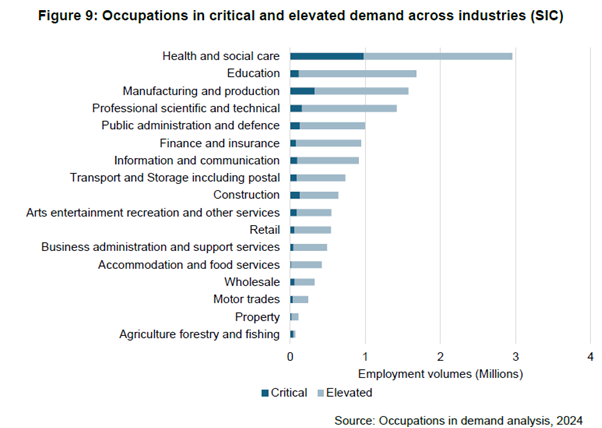
Over the coming months the industrial strategy will be refined. Sub-sectors will emerge from the eight growth driving sectors (see Box 1). Skills England, meanwhile, has identified sectors which have large numbers of jobs in occupations in critical and elevated demand (see Box 2).
Box 2
Source: https://www.gov.uk/government/publications/skills-england-report-driving-growth-and-widening-opportunities
A key challenge for the Industrial Strategy Council is to work with Skills England to identify relevant overlaps between sub-sectors and occupational skill demands, without falling into the trap of micro-management and prescriptive planning.
Challenge four: Skills England should be protected from ministerial whim
The Industrial Strategy Council has been placed on a statutory footing to ensure independence and longevity. The government must ensure that Skills England is not at the behest of ministerial whim or under constraints from departmental officials.
To ensure this happens, the best move would surely be to give Skills England greater independence from the Department and a mixed leadership group drawn from business and unions, as well as government.
Challenge five: The government should develop a shared industry and skills plan
The government should ensure that the skills strategy in England is aligned with the priorities of the industrial strategy. This implies the Department for Education and Skills England and the Department for Business and Trade and the Industrial Strategy Council developing a shared industrial skills plan. A joint industrial skills plan will require a far greater level of engagement and flexibility in thinking.
Neil Carberry is Chief Executive of REC
Our regular guest policy views are written by senior leaders and thinkers. They aim to stimulate discussion, identify issues and contribute to debate on post-16 education, skills and employment policy. The opinions expressed are the authors' own and do not necessarily express the views of the Campaign for Learning