The forthcoming white paper on post-16 education and skills means we must assess education and skills policy in England in terms of post-16, rather than 16-18 and post-18.
When we do so, we find that nearly 60% of the cash outlay on provision and maintenance support takes the form of income contingent loans.
At the same time, the debate over modules is spanning both loan funding and grant funding.
Post-16 White Paper
After the Spending Review on 11 June and before parliamentary recess on 22 July, the long-awaited post-16 education and skills paper is expected to be published.
Rather than published separately, work on higher education reform will be incorporated into the post-16 white paper.
We can expect the post-16 white paper to be significantly deeper and broader than the review of post-18 education conducted under the previous administration.
It is likely to be deeper in many ways.
First, by taking into account the devolution of adult skills at Level 3 and below.
Second, providing more detail on Level 4-6 funding through the Lifelong Learning Entitlement (LLE) including Level 4-5 credit-modules.
Third, discussing Level 7 and Level 8 master's and doctoral funding.
Fourth, looking at post-16 apprenticeship funding – including the removal of funding for Level 7 apprenticeships aged 22 and over – and the shift to the Growth and Skills Levy (GSL), especially the funding of non-apprenticeship training such as employed Skills Bootcamps and modular training demanded by employers.
Fifth, the potential introduction of a ‘Higher Education and Skills’ levy on international undergraduate and post-graduate students and the redistribution of funding across the higher education and skills systems.
And in a major departure the post-16 white paper will be wider than the post-18 review because it covers 16-19 education and Level 3 and below provision for young people, where loan funding doesn’t apply.
Loans: much funding, many streams
Whatever the ultimate shape of the new post-16 education and skills strategy in England, loan funding will be central to it.
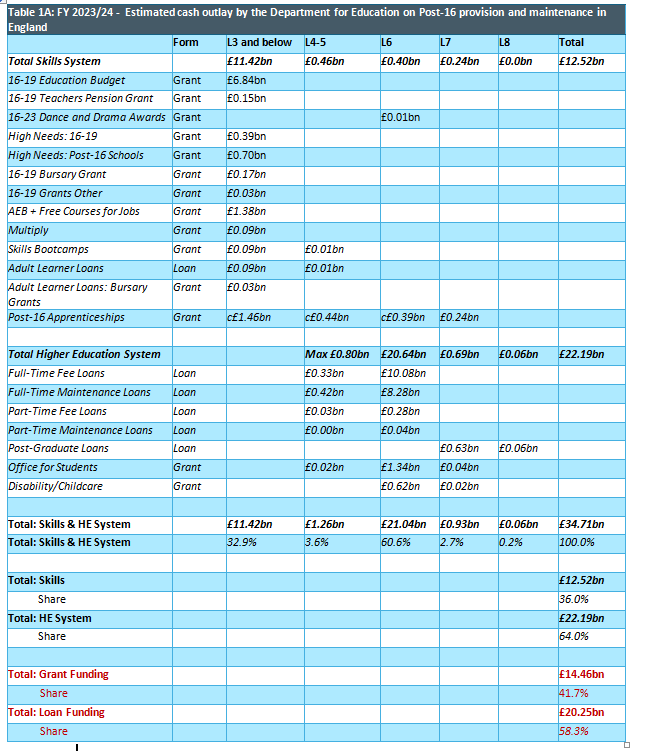
By way of illustration our best estimate is that total cash outlay on provision and maintenance on post-16 education and skills by the Department for Education in financial year 2023/24 was c£34.7bn (see Table 1A and Table 1B). Of this, nearly 60% was loan funded.
Loan funding only amounts to £100m out of £12.5bn cash outlay in the skills system compared to £20.15bn in the higher education system out of a total outlay of £22.19bn.
Critically, loan funding does not operate in 16-18 education – a crucial extension of the white paper compared to the post-18 review – or apprenticeship funding.
Purpose
The tables seek to estimate the total cash outlay by DfE on provision and maintenance support on post-16 education and skills.
Sources
(1) DfE Mains and Supplementary Spending Estimate Memoranda (2) Parliamentary Answers (3) DfE Annual Reports (4) Institute for Fiscal Studies Education Report, January 2025 (5) ESFA 16-19 Allocations February 2025
Notes
Funding for Dance and Drama Awards is available at Level 5-6 but the estimate is allocated in full to Level 6. Post-16 apprenticeship funding excludes spending on digital services, marketing and campaigns. The division of the Office for Student budget is tentative.
Funding for Disability and Childcare in higher education is allocated in full to Level 6 (although it covers L4-6) and to Level 7 (although it covers L7-8).
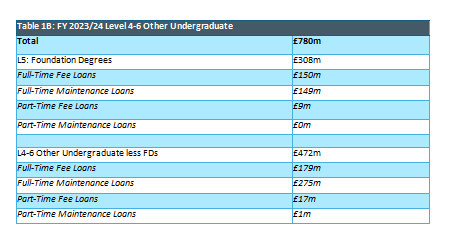
The total cash outlay of fee and maintenance loans for ‘Other Undergraduate in 2023/24 was £780m. Of this, £308m was for Foundation Degrees, leaving £472m for Level 4-6 Other Undergraduate which is not Foundation Degrees. We are seeking further information to obtain a more detailed breakdown. For now, total loan outlay for Other Undergraduate is allocated as Level 4-5 which is obviously a maximum value as it includes loan funding for non-first-degree Level 6 courses.
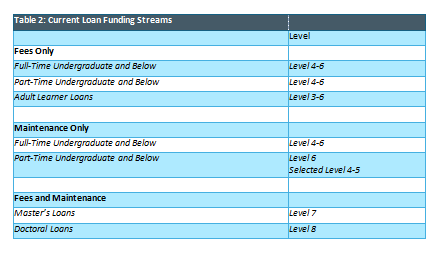
There are also many funding streams through loans in the post-16 education and skills system - seven in fact (see Table 2) – three of which are fee-loans only, two maintenance loans only and two funding fees and maintenance together.
It is worth mentioning that although adult leaner loans – which are fee-only loans – fund Level 4-6 courses, the amount is only £11m (about 13% of the total).
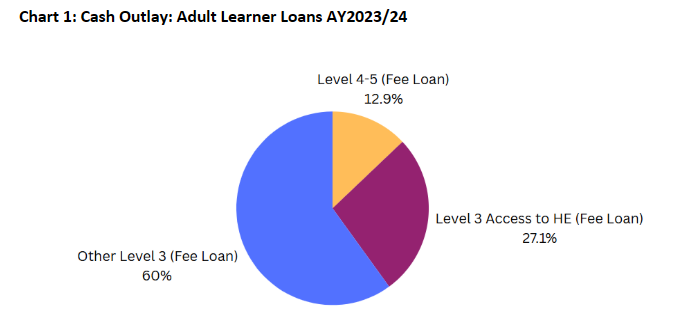
Total £86m
Level 4-5: £11m Level 3 Access to HE: £23m Other Level 3: £52m
Another aspect is that Adult Learner Loans fund Level 3 Access to HE courses. Instead of a national entitlement to maintenance loans, students are able to apply for cash-limited low value bursaries. If a student completes their course and progresses into higher education, their loan is written off.
Loans and the Lifelong Learning Entitlement
A key reform to loans in the post-16 education and skills system is the Lifelong Learning Entitlement to support upskilling and reskilling at Level 4-6 through a fee-loan entitlement of £38,140 (equivalent to four years of the maximum fee for full-time domestic students of £9,535).
From September 2026, learners will be able to apply for LLE funding for courses and modules starting from January 2027. As most undergraduates start in September and October, the LLE will be fully operational from autumn 2027.
When introduced, the Lifelong Learning Entitlement will create a single unified system of fee-loans at Level 4-6.
While the LLE might ‘tidy up’ some aspects of the loans system it will not be the only loan scheme in town (see Table 3). The number goes down from seven to six. Adult Learner Loans remain as they continue to fund Level 3 courses.
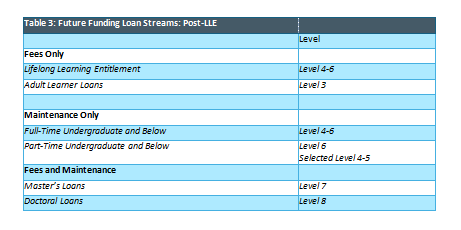
It is not beyond the realms of reality that the number of loan funding streams increases back to seven.
The decision by DfE to restrict funding for Level 7 apprenticeships to under 22 means adults aged 22 and over will need to secure alternative sources of funding.
One possibility would be to introduce Level 7 Apprenticeship Loans. They would need to be separate from Level 7 Master’s Loans.
Level 7 Master’s Loans fund fees and maintenance whilst apprenticeships fund the cost of training only. Funding for Level 7 apprenticeships of c£20K exceeds the maximum available under Level 7 Master’s Loans of c£13K.
Flesh on the LLE Bones
Looking towards 2027, the Lifelong Learning Entitlement (LLE) is designed to replace all tuition funding for Level 4 to Level 6 education (Policy Paper, Lifelong Learning Entitlement: Overview, DfE 26th February 2025).
As well as enabling upskilling to level 4, Level 5 and Level 6 the LLE aims to encourage reskilling at Level 6, Level 5 and Level 4.
In addition to funding traditional degrees, the LLE will fund post-graduate certificates, integrated master’s degrees, foundation years, all Higher Technical Qualifications (including full courses and modular courses) and modules of some Level 4-5 technical qualifications.
A minimum of 30 credits is the starting point under the LLE. 30 credits can be split into modules: for example, a single module of 30 credits, or two modules of 15 credits each.
We are promised more flesh on the LLE bones at the Spending Review. And it is certainly needed.
We need to know if the LLE will fund existing graduates with a Level 6 to participate in lifelong learning through studying a second Level 6 – both in humanities and social sciences as well as STEM subjects – through part-time higher education.
And we need to know the maintenance arrangements supporting the use of the fee-loan LLE. We need to know if maintenance loans will be extended to students seeking a first Level 4-5 through part-time study as well as reskilling at Level 4-6.
Skills England and the LLE
It was recently announced by the Department for Education (DfE) that Skills England would have an important role in ensuring the Lifelong Learning Entitlement meets national and local skills needs, and the skill needs of young people and adults.
This is an intriguing development bearing in mind that the Office for Students (OfS) is the primary regulator for the higher education system and higher education institutes, and universities have autonomy to develop non-credit/modular HTQs including full-time and part-time Level 4 and 5 foundation degrees, HNCs and HNDs.
Growth and Skills Levy
As the Government proceeds with the introduction of the Lifelong Learning Entitlement, it also plans to turn the UK Apprenticeship Levy into a Growth and Skills Levy (GSL).
While we are waiting for details the working assumption is that for levy paying employers in England, if they spend a certain amount on apprenticeships, they will be able to spend the remainder on non-apprenticeship training.
We expect funding to include Skills Bootcamps and credit-modules demanded by employers.
If the government is bold and innovative, employers should be able to cover the cost of part-time undergraduate degrees.
Earlier in May, the government announced that the Apprenticeship Budget in England will increase to £3,075m in 2025/26 compared to £2,729m in 2024/25, a rise of 13% (DfE’s Apprenticeship Budget passes £3bn mark, FE Week, 16 May 2025). This was later confirmed by the Secretary of State (Next generation of builders and carers set to rebuild Britain, DfE Press Release, 27 May 2025).
Yet, we have no launch date for the Growth and Skills Levy or its design principles.
Presumably legislation is needed to change the name of a tax, in this case from the UK Apprenticeship Levy to the Growth and Skills Levy.
As the apprenticeship levy is name-checked at each fiscal event by the OBR in their Economic and Fiscal Forecast, they too will need to know when the change of name will happen.
A good bet might be the Autumn Budget due in October or November this year.
More substantively, to launch the GSL the Government must have resources to fund both apprenticeships and flexible training, especially since it will take time for savings from the defunding of Level 7 to work through.
Lifelong Learning Entitlement and Growth and Skills Levy: overlaps
We know that the individually driven loan-based LLE for Level 4-6 courses will be open for business in January 2027 and fully operational from September 2027.
If April 2026 is too sharp, maybe, just maybe, the employer-driven grant-based Growth and Skills levy in England will be ready to rock and roll from April 2027.
Anything might happen between now and then but there is less certainty over the Growth and Skills Levy.
But we should bear in mind another critical overlap between the LLE and the GSL, the higher education system and the skills system, and Skills England and the Office for Students: that is modular provision.
HEIs have the autonomy to turn their existing degrees into credit-based modules funded through the LLE.
Then we have credit-based modules for higher technical qualifications also funded through the LLE.
And then there is the potential for modules demanded by employers and funded through the flexible training element of the Growth and Skills Levy.
All eyes are on the degree of overlap between loan funded credit-modules via the LLE and grant funded credit modules via the GSL.
Loans and Priority Sectors
The likelihood is that seven out of the eight industrial sectors and one of the two other priority sectors will primarily demand Level 4-8 skills (see Box 1), the exceptions being Clean Energy and Housebuilding.
Jonathan Woodhead is a policy adviser at Birkbeck University and Mark Corney is a senior policy adviser at Campaign for Learning
Our regular guest policy views are written by senior leaders and thinkers. They aim to stimulate discussion, identify issues and contribute to debate on post-16 education, skills and employment policy. The opinions expressed are the authors' own and do not necessarily express the views of the Campaign for Learning