Data published by the Department for Work and Pensions shows that around 43,000 young people aged 16-24 in England and Wales could lose the standard or enhanced rate of the daily living element of Personal Independence Payments (PIPs).
This is because they score less than 4 points in any of the ten daily activities used to determine eligibility for the daily living element (DLE). As a consequence, these 43,000 young people (see Table 1) will lose between £4,000 and £5,750 per year at the current rates.
Table 1

Source: FOI Request, DWP, 8 May 2025 answered on 6 June 2025
The government has now published the Universal Credit and Personal Independence Payment Bill. According to the government, part of the case for change in eligibility for PIP is due to the fact that “almost 1 million young people – 1 in 8 – are not in education, employment or training” (DWP Press Release, 18th June 2025).
But a critical question to ask is whether the loss of the daily living element of PIP will increase the number of 18–24-year-olds who are NEET (Not in education, employment and training) rather than reduce it.
Although we now know that 11,460 of the 43,000 young people claiming PIP (DLE) are employed, we do not know if they are employed and not in full-time education or employed and studying full-time. And although we now know 30,990 young people are non-employed we do not know if they are in full-time education, unemployed or inactive and studying part-time or NEET (see Diagram 1).
Diagram 1
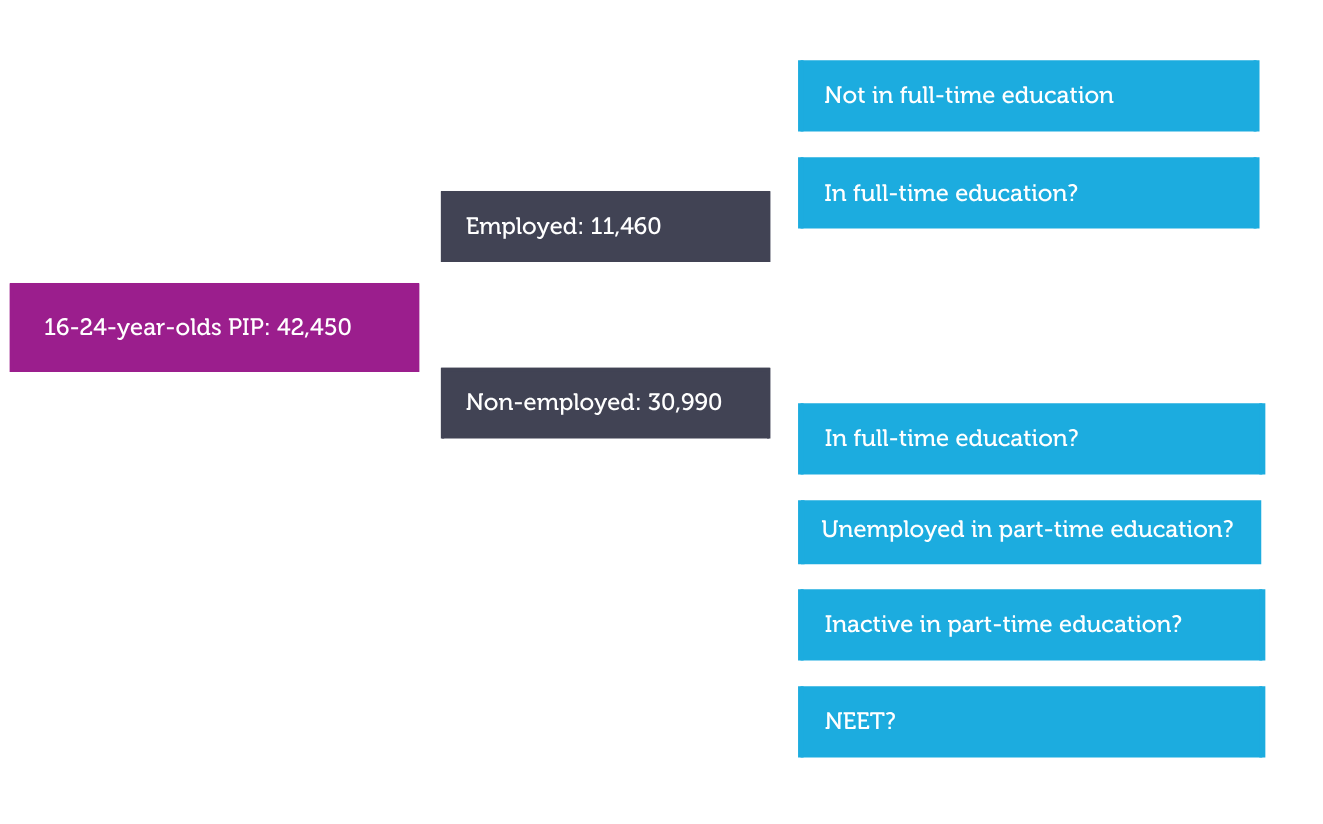
The idea, however, that the loss of PIP could increase NEET would be perverse. Parliament needs to be in a position to scrutinise the impact of the loss of PIP on 16–24-year-old NEET numbers before the Universal Credit and Personal Independence Payment Bill becomes law.
A significant number of young people
Although the number of 16–24-year-olds scoring under 4 points in any daily living activity as a proportion of all those aged 16 and over doing so is small at 3%, and this group of young people is less than 0.6% of the population of 16–24-year-olds in England and Wales, 43,000 is still a significant number.
The 43,000 16–24-year-olds expected to lose the daily living element of PIP in England and Wales are together equivalent to the population of the town of Grantham in Lincolnshire and more in number than the size of the Royal Navy. And importantly, we should not forget that each one of the 43,000 is a young person with their own needs and their lives ahead of them.
The NEET category
Young people in employment, education and training fall into three categories: those who are in paid work (employed or self-employed), those in full-time education and those who are unemployed or inactive studying in part-time education. The rest are classified as NEET.
NEET and PIP
If the 43,000 young people aged 16-24 who are likely to lose the daily living element of PIP are already NEET, the loss of income from PIP will not affect the number who are NEET.
On the other hand, NEET would rise if the entire group are in employment, education or training and the loss of income from PIP causes drop-out from employment, full-time education or part-time education if claimants are unemployed or inactive.
Between January and March 2024, the time period comparable to the PIP data, there were 930,000 16–24-year-olds who were NEET in the UK or 12.8% of the 16-24 population. For the 18–24-year-old population in the UK, 859,000 young people were NEET between January and March 2024, a rate of 15.1%.
Bearing in mind that the data on PIPs is for England and Wales, if the entire group at risk of losing PIP (DLE) are in employment, full-time education or are workless studying part-time and they drop out from these positive activities, the NEET rate in the UK would rise to 13.4% from 12.8% for 16-24 year-olds.
But given most young people at risk of losing PIP (DLE) are aged 18-24, if all are in employment, education or training, the UK NEET rate would rise to 15.8% from 15.1%.
Not knowing the NEET status of PIP claimants without 4 points in the daily living element
The problem is that neither the Department for Work and Pensions, or the Department of Education ,know whether the 43,000 16–24-year-olds at risk of losing either the standard or enhanced rate of the daily living element of PIP because they do not score 4 points in any daily activity are NEET or not. And so, it is unclear why the government can claim reforming PIP will reduce the number of young people that are NEET.
Characteristics of PIP claimants without 4 points in the daily living element
Data published by DWP as part of a Freedom of Information Request (FOI) answered on 6th June (DWP, 6 June 2025), shows that 27% of the 43,000 young people potentially affected by the loss of the daily living element of PIP are employed.
Even so, we cannot tell how many are in employment and not in full time education, or in full time education and working. If the former group drop out of employment due to the loss of PIP, NEET will rise. If the latter group drop out of their student job and full-time education only then will NEET rise.
Equally important, we have no idea of the status of the remaining 73% who are not working. They could be in full-time education, they could be unemployed and studying part-time, they could be inactive and studying part-time, or they could be NEET.
DWP in their FOI response stated that they had no information on whether these young people were in full-time or part-time education.
At the same time, in an initial FOI response, the DfE said it had no information on whether young people in full-time or part-time education were claiming PIP and were NEET or not. (DfE, 21 May 2025).
In a further FOI response (DfE, 24 June 2025), the Department for Education has stated that data is available on the number of young people for each age group between 16-24 who are claiming any form of PIP – the mobility element and/or the daily living element – and whether they are in Employment, Education or Training (EET) or Not in Employment, Education and Training (NEET), albeit for 6 years ago (see Chart 1 and Table 2).
Chart 1
Number of 16-24 year-olds in England by age group claiming PIP (Mobility and/or Daily Living Element) in 2019/20
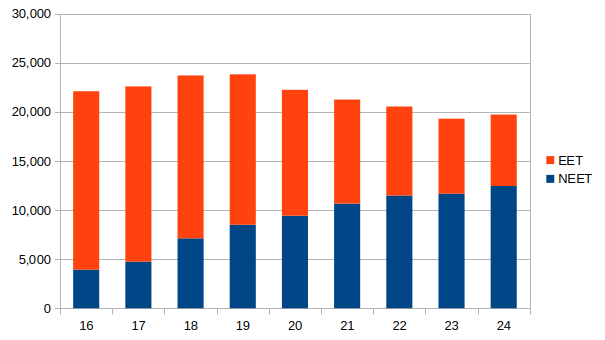
Source: Created by Paul Bivand, FOI, DfE, 24th June 2025
FOI Notes:
Age in each cohort is determined using birth month and year from KS4 data to align with the 2019/20 tax year.
For example, the age 16 KS4 cohort includes individuals born between April 2002 and March 2003, ensuring they are aged 16 at the start of the tax year.
2) Individuals are considered PIP claimants if they had an active claim at any point during the 2019/20 tax year.
3) The KS4 cohort includes students who attended state schools and independent schools in England.
4) The education data (KS5, HESA, LILR) covers the 2019/20 academic year.
5) Employment data in this context covers individuals who have received either P14 (earnings) or
Self Assessment earnings, alongside the P45 (employment) data, all covering the 2019/20 tax year.
Table 2
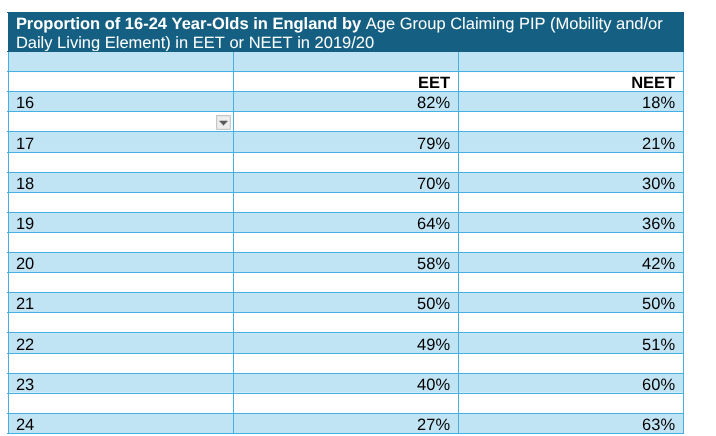
Source: Created by Paul Bivand, FOI, DfE, 24 June 2025
FOI Notes as per Chart 1
This data clearly indicates that not all 16-24 year-olds in receipt of any form of PIP were NEET some six years ago in 2019/20.
And it provides a degree of certainty that a significant proportion of 16-24 year-olds due to lose the daily living element of PIP because they fall below the 4 point threshold are in employment, education and training (especially full-time education).
Employment: behavioural change and increasing NEET
A critical point in the debate on PIP reform is whether the payments for daily living enables claimants to work and if payments are withdrawn whether claimants would work longer hours or leave employment. For those employed 16–24-year-olds who are not in full-time education and face losing PIP (DLE), the choices may be that they work longer hours, or become unemployed and therefore NEET. For those who are combining employment with full-time education, the loss of PIP might cause young people to cease working but they would only become NEET if the loss of PIP payments also caused them to drop out of full-time education.
Full-time education and PIP
Although we do not have a precise breakdown of the 31,000 non-employed 16–24-year-olds in receipt of PIP (DLE) without 4 points in any activity, it is highly unlikely they are all NEET. Many will be in full-time education (see Chart 2).
Chart 2
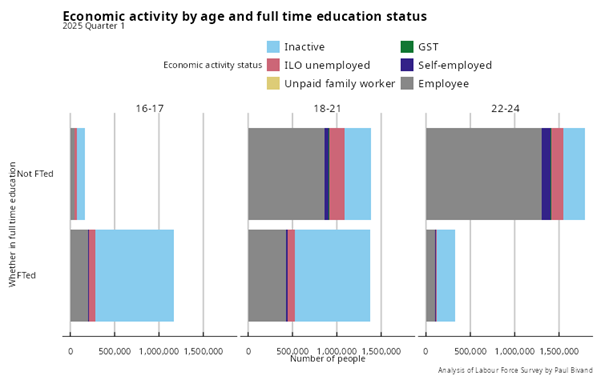
During January and March 2025, in England around 85% of 16–17-year-olds were in full-time education – primarily full-time further education at Level 3 and below – and 50% of 18–21-year-olds are in full-time education – some in full-time further education but most in full-time higher education (Level 4-6).
Only between the ages of 22-24 does full-time education fall to around 10%, Of these, most students will be in full-time higher education including some on post-graduate degrees (Level 7-8).
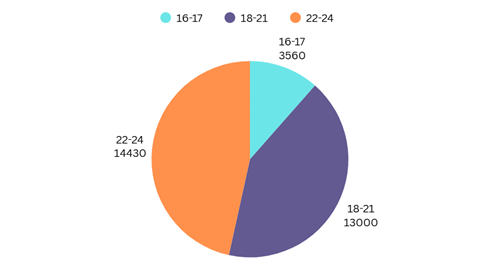
It is also likely that a large proportion of the 3,560 non-employed 16–17-year-olds claiming the daily living element of PIP below the 4 point threshold (see Chart 3) are in full-time FE given 84% of the entire cohort are in full-time further education.
Chart 3
Number of Non-Employed PIP Claimants aged 16-24 scoring less than 4 points in Daily Living Activities by Work Status and Award England and Wales, March 2024
Source: FOI Request, DWP, 8 May 2025 answered on 6 June 2025
Similarly, we can assume a significant proportion of the 13,000 non-employed 18–21-year-old PIP (DLE) claimants are in full-time education, given 50% of the cohort are in full-time education, although they are likely to be in full-time HE (Level 4-6).
Although the highest number of non-employed PIP (DLE) claimants are aged 22-24 (14,430) which correlates with a full-time education participation rate of around 10%, some may be in higher education and especially post-graduate HE (Level 7-8).
Full-time education: behavioural change and increasing NEET
To date, the debate on PIP reform has concentrated on whether employed claimants losing between £4,000 and £5,750 per year would leave employment and become unemployed or more likely inactive.
But there has been hardly any discussion about whether the loss of between £4,000 and £5,750 per year will reduce participation in full-time education and a subsequent increase in NEET.
Protection for 16–17-year-olds
The data shows that 550 employed and 3,560 non-employed 16–17-year-olds claiming PIP (DLE) are below the 4 point threshold. To protect this group, the government is consulting on extending the current Disability Living Allowance for children up to age 16 (DLAc) to the 18th birthday.
The highest rate of DLAc is equivalent to the enhanced rate of PIP (DLE) of £5,740,80 per year. The middle rate and lower rates are £3,842.80 and £1,514.80 per year respectively.
There will be winners and losers in terms of eligibility and loss of income relative to PIP. But the desire to participate in some form of positive activity on the part of parents and guardians – especially full-time and part-time further education and training even if employment ceases – probably means a rise in NEET for 16–17-year-olds will be low.
18-24-year-olds in full-time education: PIP reform and NEET
This suggests that the policy focus should be on the 13,000 aged 18-21 and the 14,430 aged 22-24 who are non-employed PIP (DLE) claimants below the 4 point threshold.
To reiterate, a fair assumption is that a significant proportion of 18–21-year-olds could be in full-time education – with some aged 18-19 in full-time further education but most in full-time higher education (Level 4-6), and a sizeable proportion of 22–24-year-olds in full-time undergraduate and post-graduate higher education (Level 7-8).
A small number of the 27,430 non-employed PIP (DLE) group could also be unemployed or economically inactive but studying part-time in FE and HE.
None of these young people will be NEET.
Without additional data, however, we do not know how many are in education and therefore not NEET. But if the entire 27,330 non-employed PIP (DLE) claimants aged 18-24 are in full-time education and the loss of £4,000 and £5,750 per year causes them to drop out, the NEET rate using March 2024 as the baseline would rise from 15.1% (859,000) to 15.6% (886,000).
In addition, extending DSAc to the 18th birthday will push back the date from which PIP can be claimed from leaving compulsory secondary education at age 16 to the compulsory participation age on reaching 18.
As a consequence, eligibility for PIP coincides with applying for full-time HE at age 18.
Policy makers must ensure that an unintended consequence of the reform to PIP does not lead to a fall in participation in further and higher education, thereby causing a structural rise in NEET amongst 18–24-year-olds however small that rise might be.
Impact on FE and HE Providers
Despite announcements in the Spending Review, we know FE and HE providers need to recruit as many young people as possible to remain financially viable.
For illustrative purposes, if 5,000 young people aged 18-19 claiming the daily living element of PIP are in full-time further education in England and the loss of benefit causes drop out, the cost to the FE sector as a whole would be c£25m.
Meanwhile, if 5,000 young people aged 18-24 claiming the daily living element of PIP are in full-time higher education and Level 4-6 in England and the loss of benefit causes drop out, the cost to the HE sector as a whole – universities and colleges – would be c£50m.
Implications for student support for PIP claimants in full-time FE and HE
A complex system of support exists for disabled students in studying in further and higher education. Providers receive extra funding to support students whilst disabled students themselves can apply for student support. Some providers also assist students to make claims for benefits including PIP.
In recent years, there has been a rise in the number of students reporting mental health problems in FE (see Poor mental health is the top reason for student absence, say colleges, AoC, 17th May 2024) and HE (see Student Mental Health in England, House of Commons Library, 28th April 2025).
Around 19% of PIP claimants of working age falling below the 4 point threshold report having ADHD/ADD and 48% with anxiety and depression (DWP, FOI, 17th April 2025).
Loss of the daily living element of PIP by 18–24-year-olds in full-time further and higher education who report mental health problems suggests that FE and HE providers and affected students could need extra financial support to avoid potential drop-out and a rise in NEET numbers.
Youth Guarantee Group: 18–21-year-olds
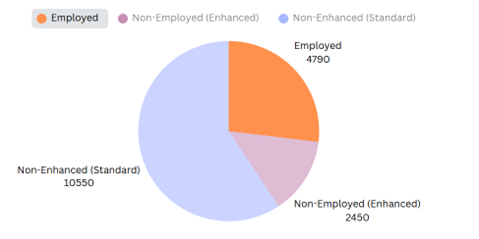
Similar arguments apply to the most-favoured group for education and labour market policy in England – 18–21-year-olds. It is imperative that the PIP reforms do not lead to any of 4,800 young people aged 18-21 who are employed or some of the 13,000 who are in full-time FE and HE or workless and studying part-time from dropping out (see Chart 4). Otherwise, NEET numbers will rise.
Indeed, if the PIP reforms lead to a rise in the 18-21 NEET group, the Youth Guarantee will need to work even harder to ensure every young person is looking for work, earning or learning.
Chart 4
Number of Non-Employed PIP Claimants aged 18-21 scoring less than 4 points in Daily Living Activities by Work Status and Award England and Wales, March 2024
Source: FOI Request, DWP, 8 May 2025 answered 6 June 2025
Stocks and flows
The number of 16-24-year-olds claiming the standard or enhanced rate of the daily living element of PIP is a stock figure as of March 2024. The government plans to implement the reforms to personal independence payments from November 2026.
The loss of payments for existing claimants will be determined when the person is due for reassessment. If at this stage young people lose their PIP (DLE) and it causes the loss of employment and drop out of education, the NEET numbers will rise.
For new claimants from November 2026, the prospect of much tighter eligibility to gain PIP (DLE) might show up as an unwillingness to apply for full-time further and higher education. And if they do not secure a job, the NEET numbers again will rise.
All this suggests that the potential rise in the NEET population will take place over time.
Actions
There are seven actions the government should take as a matter of urgency.
Action 1
DWP and DfE should work together to assess how many of the 11,460 employed 16-24-year olds who might lose their PIP (DLE) are currently a) in employment and not in full-time education, and b) in full-time education and working. This will enable an assessment of whether the removal of eligibility to PIP (DLE) from the first group will lead to unemployment and therefore a rise in NEET, and in the second group whether PIP (DLE) removal will lead to both loss of employment and drop-out from full-time education and therefore a rise in NEET too.
Action 2
DfE and DWP must undertake urgent research into the education status of the 31,000 non-employed young people aged 16-24 claiming PIP (DLE) below the 4 point threshold – split between 16-17, 18-21 and 22-24 - to determine whether they are NEET or not.
Action 3
DfE and DWP should determine how many of the 31,000 non-employed young people aged 16-24 are in full-time further education at Level 3 and below; full-time higher education at Level 4-6; full-time higher education at Level 7-8, and those who are workless studying part-time in FE and HE.
Action 4
DfE and DWP should examine the extent to which the loss of between £4,000 and £5,750 per year due to the removal of eligibility for PIP (DLE) could increase poverty amongst full-time further education students – especially those aged 18-19 – and full-time higher education students – especially those age 18-21 - and lead to drop-out and thereby a rise in NEET.
Action 5
DfE and DWP should examine the impact of extending the DLAc to age 18, for young people continuing full-time further education between age 18-19, and applying for full-time higher education at age 18-19, the peak years for new entrants.
Action 6
DfE and DWP should examine the case for extending support to FE and HE providers, and students themselves to ensure the loss of the daily living element of PIP does not lead to drop-out or fewer applications to full-time FE by 18–19-year-olds and 18–24-year-olds in full-time HE.
Action 7
DfE and DWP should consider extending DLAc up to the 20th birthday in cases where 18–19-year-olds stay-on in full-time further education.
Paul Bivand is a Labour Market Analyst. Contact Paul: [email protected]
Mark Corney is Senior Policy Adviser at Campaign for Learning
Our regular guest policy views are written by senior leaders and thinkers. They aim to stimulate discussion, identify issues and contribute to debate on post-16 education, skills and employment policy. The opinions expressed are the authors' own and do not necessarily express the views of the Campaign for Learning